
Training Cats: Possibilities, Limitations, and What the Research Actually Shows
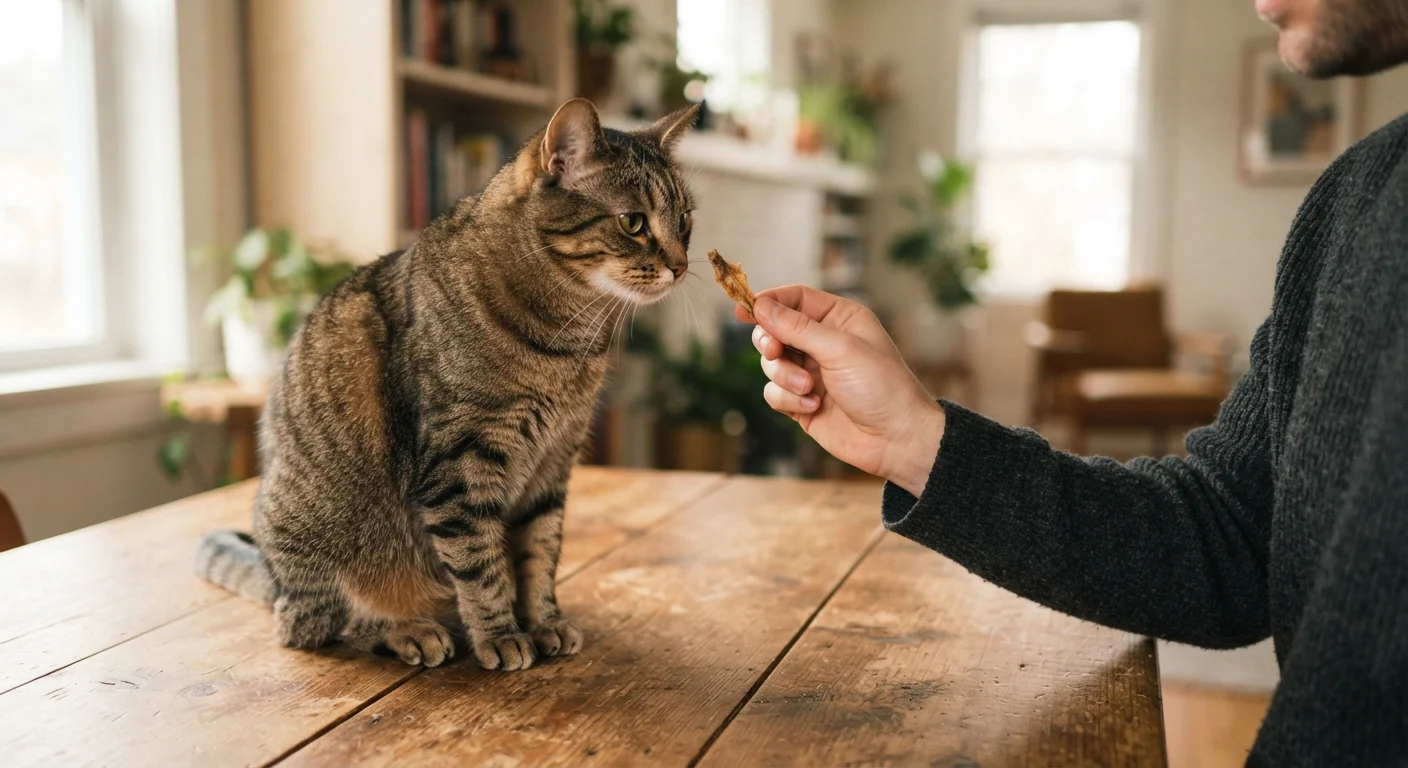
Photo credit: PrimeFaqs.com | Trending And Accurate Content
In this article
Cats can be trained—but not the same way dogs are. Explore what feline cognition research reveals about motivation, attention, and reward.
Key Takeaways
- Cats are cognitively capable of learning behaviors through reward-based training methods.
- Feline motivation differs fundamentally from dogs-food timing, session length, and novelty all matter more.
- Training strengthens the human-cat bond and supports mental enrichment, especially for indoor cats.
- Punishment-based approaches are ineffective and can damage trust with cats.
- Realistic expectations and short, consistent sessions produce the best results.
Cats are cognitively capable of learning diverse behaviors
Peer-reviewed research confirms cats use associative learning effectively. They can acquire practical skills-recall, carrier acceptance, cooperative handling-that meaningfully improve daily life.
Strengthens the human-cat bond
Consistent, reward-based interaction builds trust over time. Cats that are regularly trained tend to be more comfortable with handling, which also reduces stress during veterinary visits.
Supports mental health and reduces boredom behaviors
Training activates problem-solving instincts, particularly valuable for indoor cats. Short daily sessions can decrease destructive or attention-seeking behaviors linked to under-stimulation.
Cooperative care training reduces veterinary stress
Teaching cats to accept handling, nail trims, or medication willingly lowers fear responses that make routine care difficult for both owner and animal.
Positive methods are safe and humane
Reward-based cat training carries no risk of physical harm or fear conditioning. When sessions go poorly, the worst outcome is that the cat disengages-a safe and recoverable state.
Attention windows are short-sessions must be brief
Most cats disengage after two to five minutes of training. Exceeding this limit typically produces avoidance rather than continued learning, requiring owners to restructure their expectations.
Motivation is narrower and more situational than in dogs
Cats are primarily motivated by immediate tangible rewards. If a cat isn't hungry, the treat loses value; if stressed, training often fails entirely regardless of reward quality.
Progress can be slow and nonlinear
Cats may perform a trained behavior consistently for days, then appear to 'forget' it. This is often a motivational or environmental issue rather than lost learning, but it can frustrate owners expecting steady progress.
Environmental sensitivity limits training contexts
Cats trained in one location may not generalize the behavior to other rooms or settings without deliberate re-training in each context. Household disruptions can temporarily shut down learning.
Individual variation is high
Some cats respond enthusiastically to training while others show minimal interest regardless of methods used. Personality, early socialization history, and stress levels all influence trainability in ways owners cannot fully control.
What Feline Cognition Research Actually Reveals
For years, the popular assumption was that cats simply couldn't be trained-or wouldn't bother. Research published in animal behavior journals over the past two decades has overturned that notion. Cats demonstrate associative learning, can follow human pointing gestures in some contexts, and have shown the capacity to learn named object identities in controlled studies.
What the science clarifies is that cats learn differently from dogs, not less effectively. They are facultative social animals-meaning social interaction is context-dependent rather than intrinsically motivating. A cat may learn a behavior reliably but choose not to perform it if the reward isn't compelling or the timing is off. This distinction matters enormously for training strategy.
Research also confirms that cats are sensitive to operant conditioning-the same learning framework underpinning dog training. For a deeper look at how this works, see the science behind reward-based training.
Cats are cognitively capable of learning diverse behaviors
Peer-reviewed research confirms cats use associative learning effectively. They can acquire practical skills-recall, carrier acceptance, cooperative handling-that meaningfully improve daily life.
Strengthens the human-cat bond
Consistent, reward-based interaction builds trust over time. Cats that are regularly trained tend to be more comfortable with handling, which also reduces stress during veterinary visits.
Supports mental health and reduces boredom behaviors
Training activates problem-solving instincts, particularly valuable for indoor cats. Short daily sessions can decrease destructive or attention-seeking behaviors linked to under-stimulation.
Cooperative care training reduces veterinary stress
Teaching cats to accept handling, nail trims, or medication willingly lowers fear responses that make routine care difficult for both owner and animal.
Positive methods are safe and humane
Reward-based cat training carries no risk of physical harm or fear conditioning. When sessions go poorly, the worst outcome is that the cat disengages-a safe and recoverable state.
The Real Limitations: Why Cat Training Looks Different
Understanding the constraints of cat training is just as important as recognizing its possibilities. Cats have a shorter working attention window than dogs during formal training-most behaviorists recommend sessions of two to five minutes. Exceeding this threshold often produces avoidance, not learning.
Unlike dogs, who are wired to seek social approval, cats are primarily motivated by immediate tangible rewards: food, play, or access to preferred spaces. The reward must arrive within one to two seconds of the desired behavior, or the associative link weakens significantly. This makes marker training (using a clicker or a verbal cue like "yes") especially useful, as it bridges the gap between behavior and reward delivery.
Environmental factors add another layer. Cats trained in quiet, familiar spaces perform far better than those in high-distraction settings. Stress-from new animals, changes in routine, or household tension-can suppress learning entirely. Owners dealing with litter box avoidance or other stress-related behaviors may want to explore what your cat's behavior is signaling before beginning formal training.
Attention windows are short-sessions must be brief
Most cats disengage after two to five minutes of training. Exceeding this limit typically produces avoidance rather than continued learning, requiring owners to restructure their expectations.
Motivation is narrower and more situational than in dogs
Cats are primarily motivated by immediate tangible rewards. If a cat isn't hungry, the treat loses value; if stressed, training often fails entirely regardless of reward quality.
Progress can be slow and nonlinear
Cats may perform a trained behavior consistently for days, then appear to 'forget' it. This is often a motivational or environmental issue rather than lost learning, but it can frustrate owners expecting steady progress.
Environmental sensitivity limits training contexts
Cats trained in one location may not generalize the behavior to other rooms or settings without deliberate re-training in each context. Household disruptions can temporarily shut down learning.
Individual variation is high
Some cats respond enthusiastically to training while others show minimal interest regardless of methods used. Personality, early socialization history, and stress levels all influence trainability in ways owners cannot fully control.
What Cats Can and Cannot Be Taught
Cats are capable of learning a wider range of behaviors than most owners attempt to teach. Practical skills with documented success include:
- Carrier training: Gradually associating the carrier with positive experiences reduces transport stress.
- Recall: Coming when called is achievable and genuinely useful for safety.
- Stationary behaviors: Sit, stay, and targeting (touching a hand or object with the nose or paw) can be taught reliably.
- Cooperative care behaviors: Tolerating nail trims, ear checks, or medication administration reduces veterinary and home care stress.
What cats generally resist: prolonged repetitive tasks, behaviors that conflict with strong instincts (like suppressing predatory stalking mid-sequence), and training in states of high arousal or fear. Forcing compliance in these scenarios doesn't produce learning-it erodes trust.
Training Is Not the Same as Behavior Problem Solving
Formal training sessions work best when a cat is healthy, relaxed, and free of underlying behavioral or medical issues. If your cat is showing signs of anxiety, aggression, or elimination problems, consult a veterinarian or certified animal behaviorist before beginning a training program. Behavior problems and training goals are related but distinct domains.
If you've recently adopted a cat and want to establish good habits from the start, foundational training principles for new pet owners offers practical guidance on timing and consistency that applies directly to cats.
Training as Enrichment-Especially for Indoor Cats
Beyond behavior modification, training serves a welfare function. Indoor cats, in particular, benefit from the cognitive engagement that structured training sessions provide. Problem-solving for rewards activates the same neural pathways involved in hunting-providing mental stimulation that an indoor environment doesn't naturally supply.
Regular short training sessions can reduce boredom-related behaviors such as excessive vocalization, destructive scratching, and attention-seeking. The human-cat interaction during training also reinforces social bonds in a way that passive cohabitation doesn't. For context on the broader challenges of indoor cat enrichment, see the trade-offs between indoor and outdoor lifestyles.
2-5 min
Recommended cat training session length
Animal behaviorists consistently advise keeping feline training sessions to two to five minutes to maintain engagement and avoid avoidance responses.
1-2 sec
Reward delivery window for effective learning
Behavioral science indicates that rewards delivered within one to two seconds of the target behavior are most effective at establishing reliable associations in cats.
The key is approaching training as a cooperative activity rather than a compliance exercise. Cats that associate training sessions with predictable, positive outcomes tend to initiate engagement over time-a reliable indicator that the process is working.

Author
Pets & Animals Editorial Team
Pets & Animals Editorial Team is the collective byline for our editorial team and contributor network. Articles published under this byline or an editorial pen name are researched, written, and reviewed according to our editorial standards for clarity, consistency, and independence before publication.
View all articles →