
Added Sugar vs. Natural Sugar: Why the Distinction Matters
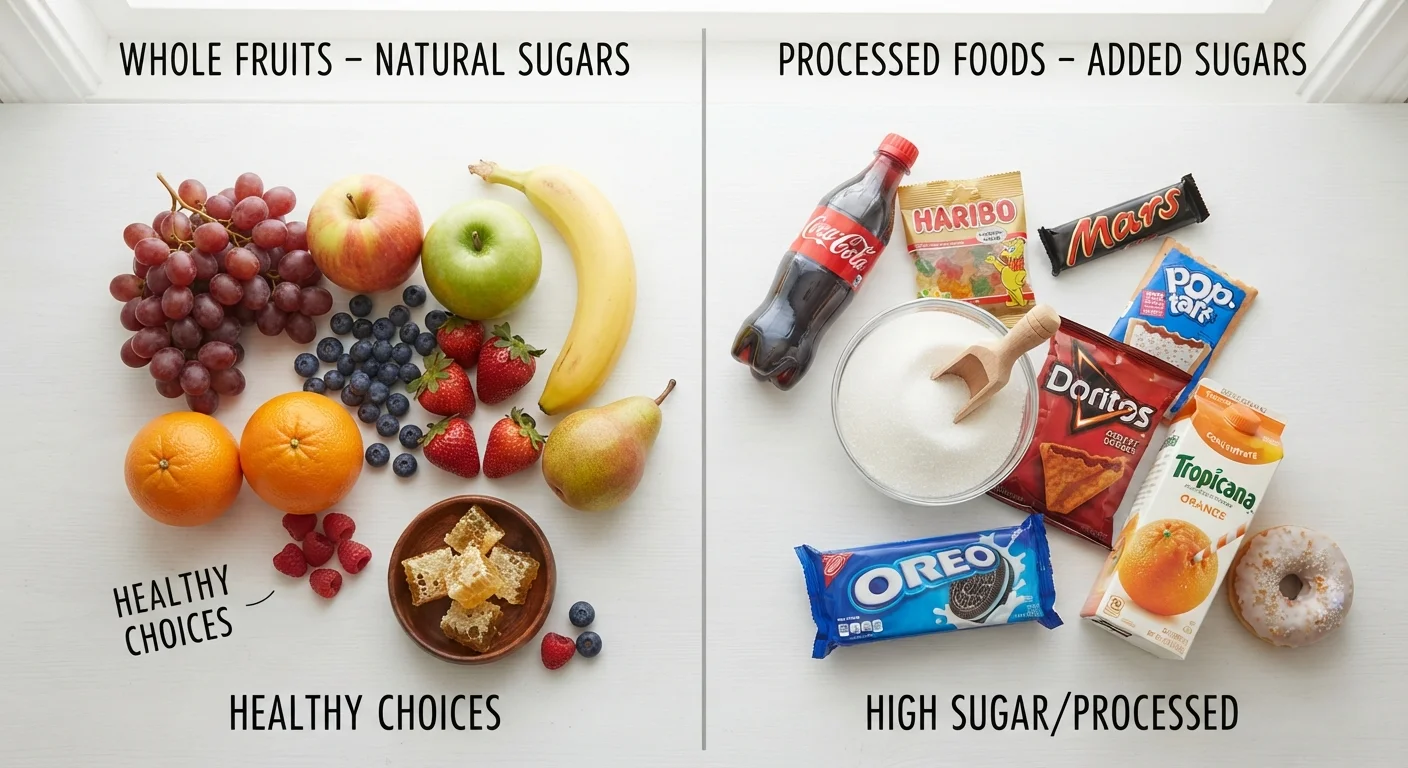
Photo credit: PrimeFaqs.com | Trending And Accurate Content
In this article
Both come from food, but the body and the research treat them differently. Here's what sets added and naturally occurring sugars apart.
Key Takeaways
- Natural sugars arrive packaged with fiber, vitamins, and minerals that slow absorption and support health.
- Added sugars provide calories without meaningful nutritional benefit and are linked to metabolic health concerns.
- The Dietary Guidelines for Americans recommend limiting added sugar to less than 10% of daily caloric intake.
- Food labels now distinguish added sugars from total sugars, making it easier to track intake.
- Fruit, dairy, and some vegetables contain natural sugars and remain encouraged as part of a balanced diet.
- Context matters: what surrounds the sugar in a food is as important as the sugar itself.
What Separates Natural Sugar from Added Sugar
At the chemical level, the glucose and fructose molecules in an apple are structurally identical to those in a soft drink. So why do nutrition scientists and public health bodies draw such a firm line between the two? The answer lies not in the sugar molecule itself, but in the nutritional company it keeps.
Natural sugars are those found inherently in whole foods - the fructose in fruit, the lactose in milk, the small amounts of glucose in vegetables. These foods are not simply sugar delivery vehicles; they carry dietary fiber, vitamins, minerals, and phytonutrients that influence how the body processes what you eat. Fiber, in particular, slows the digestion and absorption of sugars, moderating the rise in blood glucose that follows a meal.
Added sugars, by contrast, are any sugars or caloric sweeteners incorporated into foods during processing or preparation. This includes table sugar (sucrose), high-fructose corn syrup, honey, agave nectar, fruit juice concentrates, and dozens of other ingredients that appear on labels. When these sugars are added, they arrive largely stripped of the fiber and micronutrients that would otherwise slow absorption and contribute to nutritional value.
This distinction is why eating a whole orange - with its fiber intact - produces a different physiological response than drinking the same calories as orange juice with added sugar, even though both contain fructose. The food matrix matters. As discussed in our breakdown of whole versus processed foods, the degree of processing fundamentally changes what a food does in the body.
| Criterion | Natural Sugar | Added Sugar |
|---|---|---|
| Source | Inherent in whole foods (fruit, dairy, veg) | Added during processing or preparation |
| Common examples | Fructose in fruit, lactose in milk | Table sugar, HFCS, honey, agave, syrups |
| Nutritional context | Accompanied by fiber, vitamins, minerals | Little to no accompanying nutrients |
| Absorption rate | Slowed by fiber in whole foods | Typically absorbed more rapidly |
| Health guidance | Whole-food sources encouraged | Limit to <10% of daily calories (US guidelines) |
| Appears on food labels as | Part of 'Total Sugars' only | Listed separately under 'Added Sugars' |
What the Research Shows - and Its Limits
The scientific case for limiting added sugar rests on a substantial body of evidence. Consistent high intake of added sugars has been associated with increased risk of conditions including type 2 diabetes, cardiovascular disease, non-alcoholic fatty liver disease, and dental caries. The Dietary Guidelines for Americans recommend that added sugars account for less than 10% of total daily calories - for a 2,000-calorie diet, that is roughly 50 grams, or about 12 teaspoons.
17 tsp
Average daily added sugar intake for U.S. adults
According to National Health and Nutrition Examination Survey (NHANES) data, American adults consume approximately 17 teaspoons of added sugar per day - well above the recommended ceiling.
<10%
Recommended added sugar ceiling (daily calories)
The Dietary Guidelines for Americans advise that added sugars make up less than 10% of total daily calorie intake for most adults and children over age two.
~57%
Share of U.S. calories from ultra-processed foods
Research published in BMJ Open estimated that ultra-processed foods - a primary vehicle for added sugars - account for roughly 57% of energy intake in the American diet.
It is worth being precise about what this research does and does not show. Most evidence is observational, meaning it identifies associations rather than proving direct causation. Experimental studies are shorter-term and often involve higher doses than typical dietary exposure. Researchers also note that added sugar frequently travels alongside other dietary patterns - high intake of ultra-processed foods, low intake of vegetables - which complicates isolating sugar's individual effect.
Natural sugars in whole foods, meanwhile, have not shown the same associations in the research literature. Studies on fruit consumption, for example, generally find neutral to positive associations with health outcomes, likely because of the fiber and micronutrient content that accompanies the sugar.
This article is for general informational and educational purposes only and does not constitute medical or dietary advice. Readers with specific health concerns or conditions should consult a qualified healthcare professional before making changes to their diet.
How to Use This Distinction in Practice
Understanding the difference between added and natural sugar becomes most useful when applied to everyday food decisions. Here are practical ways to use this knowledge:
- Read the Nutrition Facts panel. Since 2020, the U.S. Food and Drug Administration has required most packaged foods to list Added Sugars as a separate line beneath Total Sugars. This makes it possible to see at a glance how much sugar was incorporated during manufacturing versus how much occurs naturally in an ingredient like milk or fruit.
- Look beyond grams to ingredients. Scanning the ingredients list for terms like high-fructose corn syrup, cane sugar, maltose, dextrose, or any syrup helps identify where added sugars are coming from in a product.
- Prioritize whole-food sugar sources. Reaching for whole fruit rather than fruit juice, or plain yogurt rather than flavored varieties, naturally shifts sugar intake toward forms accompanied by fiber and nutrients.
- Be cautious of health halo labels. Products described as sweetened with honey, agave, or fruit juice concentrate still contain added sugars, even if the marketing implies otherwise. These alternatives are nutritionally comparable to other added sugars for most purposes.
Making consistent, informed choices based on this distinction - rather than attempting to eliminate all sugar - reflects the kind of sustainable, evidence-grounded approach that supports long-term health without unnecessary dietary restriction.

Author
Health & Wellness Editorial Team
Health & Wellness Editorial Team is the collective byline for our editorial team and contributor network. Articles published under this byline or an editorial pen name are researched, written, and reviewed according to our editorial standards for clarity, consistency, and independence before publication.
View all articles →