
Whole Foods vs. Processed Foods: Understanding the Spectrum
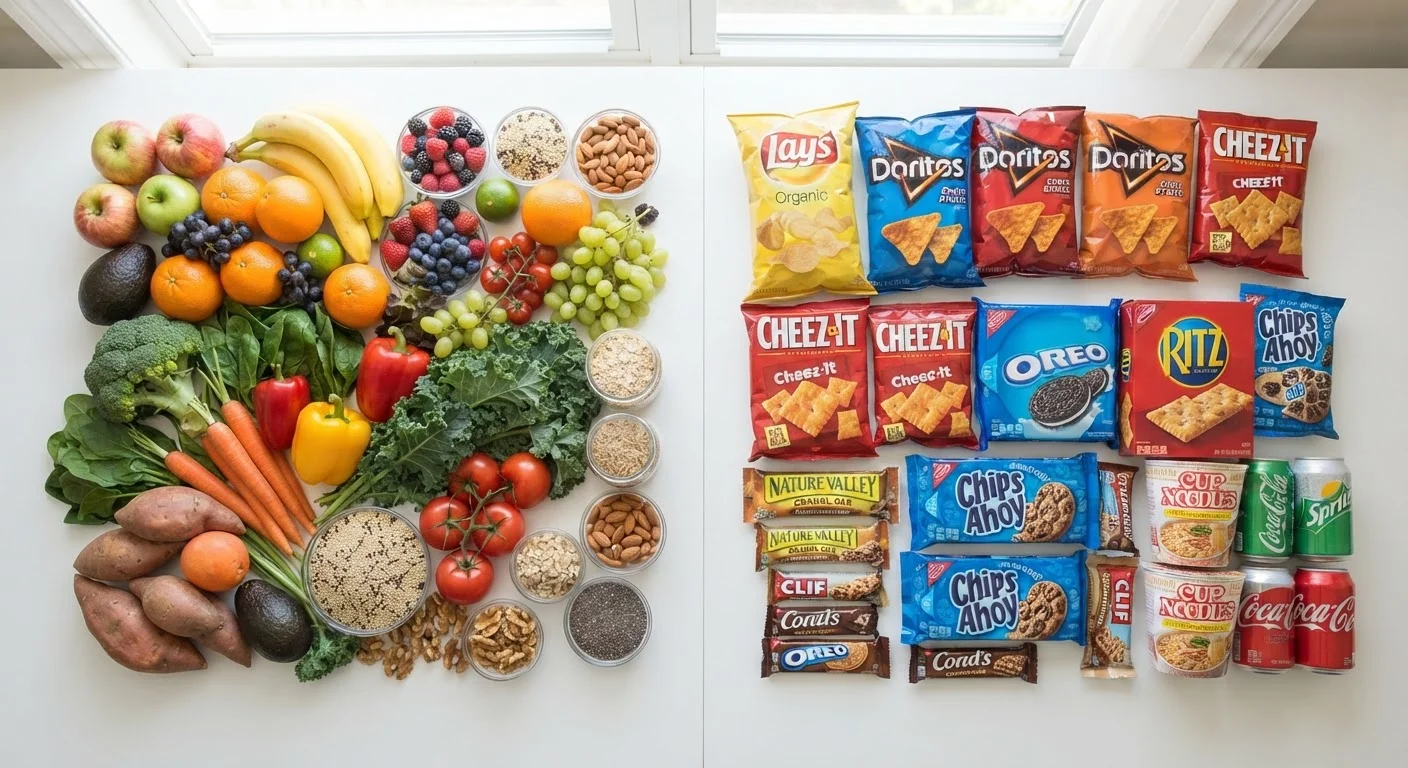
Photo credit: PrimeFaqs.com | Trending And Accurate Content
In this article
Not all processed food is equally harmful, and not all whole food is equally virtuous. Here's how to think clearly about the difference.
Key Takeaways
- Processing exists on a spectrum - canned beans and cheese crackers are not nutritionally equivalent.
- Ultra-processed foods, not processed foods broadly, are most strongly linked to poor health outcomes in research.
- Whole foods retain more fiber, micronutrients, and beneficial compounds lost during heavy processing.
- Reading ingredient lists is more informative than relying on front-of-package health claims.
- A diet can be nutritionally sound while still including some degree of processed food.
- Consult a registered dietitian for guidance tailored to your individual health needs.
Why the Binary Is Misleading
The phrase "avoid processed foods" is everywhere in nutrition discussions, yet it collapses a wide spectrum into a single category. A bag of frozen peas is technically processed. So is a packaged frosted pastry. Treating these as equivalent oversimplifies nutrition in ways that can lead to either unnecessary restriction or misplaced confidence.
Researchers have found it more useful to classify foods by degree of processing. The NOVA classification system, developed by researchers at the University of São Paulo, groups foods into four tiers: unprocessed or minimally processed foods (fresh produce, plain meat, eggs), processed culinary ingredients (oils, flours, sugar), processed foods (canned vegetables, cheeses, cured meats), and ultra-processed foods (packaged snacks, soft drinks, reconstituted meat products). The critical distinction is not processing itself, but how much a food has been transformed and what has been added or removed in the process.
Understanding this spectrum gives you a more useful lens than a simple whole vs. processed divide. For a complementary look at how food choices interact at the macro level, see our guide on nutrition habits that quietly undermine an otherwise healthy diet.
What Whole Foods Actually Offer
Whole foods - vegetables, fruits, legumes, whole grains, nuts, seeds, and unmodified animal products - are nutritionally significant primarily because of what they retain. Fiber supports gut microbiome diversity and satiety. Phytonutrients like flavonoids and carotenoids are associated with reduced inflammation in observational research. Vitamins and minerals appear in naturally occurring ratios alongside cofactors that can aid absorption.
These benefits are not exclusive to organic or expensive produce. A plain boiled lentil and a lentil from a no-salt-added can are nutritionally similar. The goal is not purity for its own sake, but maintaining the structural integrity of food that carries nutritional information your body is well-adapted to use.
| Criterion | Whole Foods | Processed Foods |
|---|---|---|
| Fiber content | Naturally high; intact | Often reduced or removed in ultra-processing |
| Added sugars | None | Common in ultra-processed products |
| Sodium | Naturally low | Often elevated for preservation or flavor |
| Micronutrient retention | High; naturally occurring | Variable; sometimes fortified artificially |
| Shelf life | Short; requires refrigeration | Extended via preservation methods |
| Ingredient complexity | Single ingredient | Ranges from simple to highly complex |
| Cost and accessibility | Variable; seasonal produce can be affordable | Often lower cost; widely available |
Protein quality is one area where whole food comparisons get nuanced. If you are weighing plant versus animal sources, our article on plant-based protein vs. animal protein explores amino acid profiles and bioavailability in depth.
Where Processed Foods Fall on the Spectrum
Not every processed food deserves the same level of scrutiny. Lightly processed items - rolled oats, canned tomatoes, plain kefir, frozen edamame - retain most of their nutritional value and often improve food access and reduce waste. The concern in nutrition research centers primarily on ultra-processed foods: products engineered with combinations of refined starches, added sugars, industrial fats, salt, and synthetic additives that are rarely used in home cooking.
A Note on Observational Research
Most studies linking ultra-processed foods to health outcomes are observational, meaning they track associations in populations rather than proving direct causation. People who eat more ultra-processed foods may also differ in other lifestyle factors. Researchers attempt to control for these variables, but the findings should be interpreted as signals worth taking seriously - not as certainties.
Studies published in journals such as The BMJ and JAMA Internal Medicine have found associations between high ultra-processed food consumption and increased risk of cardiovascular disease, type 2 diabetes, and all-cause mortality. These are observational findings - they identify correlation, not proven causation - but the consistency across large population studies is notable.
Added sugars are a frequent marker of ultra-processing and one worth tracking specifically. The relationship between added and naturally occurring sugars is explored further in our piece on added sugar vs. natural sugar. Similarly, understanding fat quality within processed products matters - see our guide on healthy fats vs. saturated and trans fats for clarity on which fat types raise the most concern.
57%
Share of American caloric intake from ultra-processed foods
Research published in BMJ Open estimated that ultra-processed foods account for more than half of daily calories consumed by U.S. adults.
4x
More additives in ultra-processed vs. minimally processed foods
NOVA classification research has found ultra-processed products contain substantially more industrial additives, including emulsifiers and artificial flavors, compared to lightly processed equivalents.
Practical Habits for Navigating the Spectrum
Rather than eliminating all processed food, a more sustainable approach focuses on shifting the balance. A few principles tend to be consistently supported by nutrition research:
- Anchor meals in minimally processed foods. Build plates around vegetables, legumes, whole grains, and protein sources that require minimal label-reading.
- Use the ingredient list, not the front of the package. Front-of-pack claims are marketing. A short ingredient list of recognizable components is a more reliable signal of light processing.
- Reserve ultra-processed foods rather than eliminating them. Restriction can create its own relationship with food that is counterproductive. A realistic goal is reducing frequency and portion, not achieving zero intake.
- Treat convenience as a spectrum too. Frozen vegetables, rotisserie chicken, and canned beans are convenient and nutritionally sound - convenience and whole-food eating are not mutually exclusive.
No single food makes or breaks a diet. Consistency of pattern over time matters far more than perfection at any individual meal. As with all dietary decisions, individuals with specific health conditions, medications, or concerns should consult a qualified healthcare provider or registered dietitian before making significant changes.
This article is for general informational and educational purposes only and does not constitute medical or dietary advice. Always consult a qualified healthcare professional for guidance specific to your health situation.

Author
Health & Wellness Editorial Team
Health & Wellness Editorial Team is the collective byline for our editorial team and contributor network. Articles published under this byline or an editorial pen name are researched, written, and reviewed according to our editorial standards for clarity, consistency, and independence before publication.
View all articles →