
Debt Consolidation: Weighing the Genuine Trade-Offs
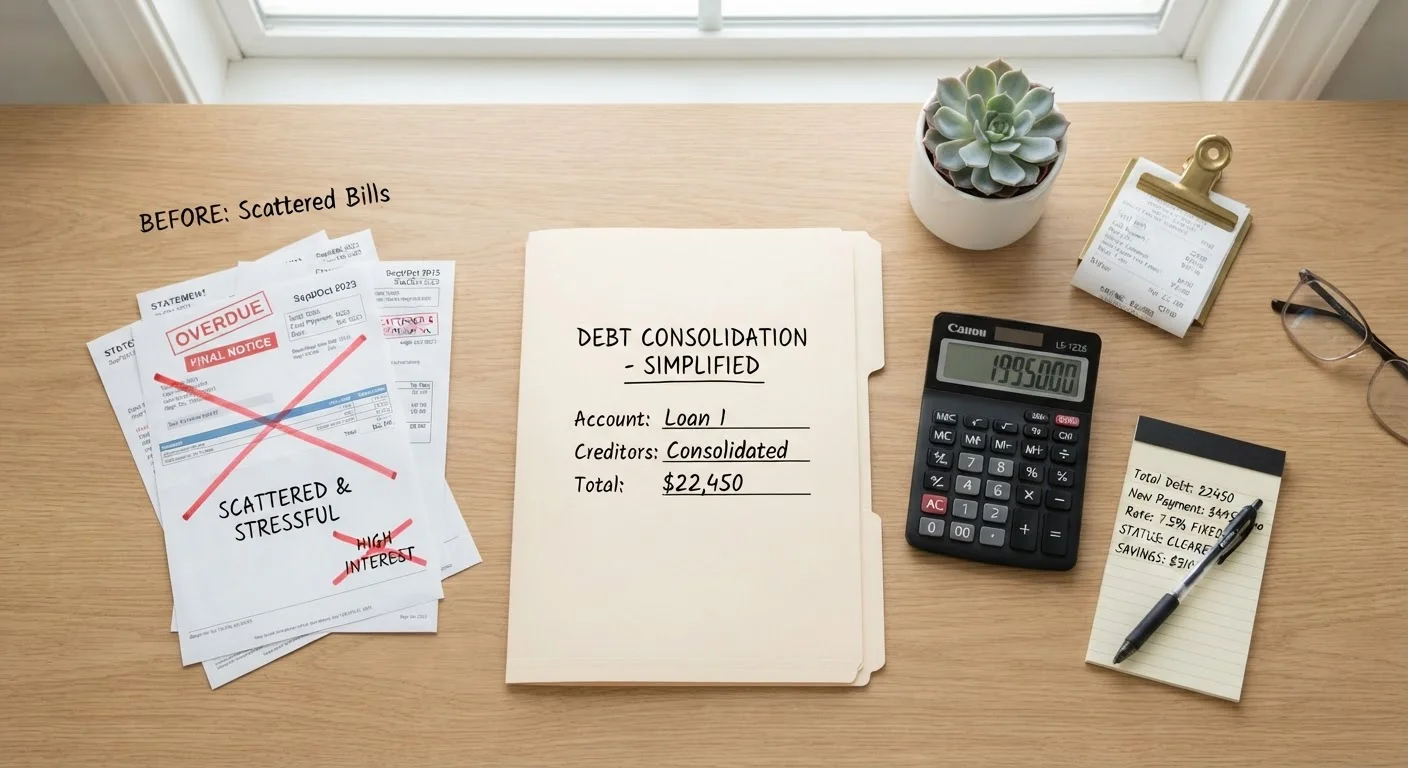
Photo credit: PrimeFaqs.com | Trending And Accurate Content
In this article
Consolidating debt can simplify payments and lower interest — but it isn't risk-free. A balanced look at what you gain and what you give up.
Key Takeaways
- Debt consolidation rolls multiple balances into one payment, potentially lowering your interest rate.
- A lower monthly payment doesn't always mean lower total cost - loan term length matters significantly.
- Consolidation may temporarily affect your credit score through a hard inquiry and new account opening.
- Without addressing spending habits, consolidation can lead to accumulating new debt on cleared accounts.
- Consulting a nonprofit credit counselor can help you evaluate whether consolidation fits your situation.
Potentially lower interest rate reduces total repayment cost
Qualifying borrowers may secure a personal loan at a rate well below the average credit card APR, which can meaningfully reduce total interest paid over the loan term - provided the loan is repaid on schedule.
Simplifies finances with one monthly payment
Replacing five or six separate due dates with a single payment reduces cognitive load and the chance of accidental missed payments, which can carry costly late fees and credit score penalties.
Fixed repayment timeline creates a clear end date
Unlike revolving credit card debt that can linger indefinitely with minimum payments, a personal loan consolidation sets a defined payoff date - often two to five years - which supports long-term financial planning.
Can improve credit utilization over time
Paying down revolving credit card balances through a consolidation loan reduces your credit utilization ratio - the percentage of available credit in use - which is a significant factor in credit score calculations.
Extended loan term may increase total interest paid
A lower monthly payment often comes from stretching the repayment period. Even at a lower rate, paying over a longer term can result in more total interest than aggressively repaying the original debts would have cost.
Qualification requires adequate credit score
The most favorable consolidation loan rates are typically reserved for borrowers with good to excellent credit. Those with lower scores may receive offers that don't meaningfully improve on their current interest burden.
Hard credit inquiry temporarily lowers your score
Applying for a consolidation loan or balance transfer card triggers a hard inquiry on your credit report, which can cause a modest, temporary dip in your credit score - typically a few points lasting up to a year.
Origination fees and balance transfer fees add upfront cost
Personal loans often carry origination fees ranging from 1% to 8% of the loan amount, while balance transfer cards typically charge 3%-5% of the transferred balance - costs that must be factored into the break-even calculation.
Doesn't address the spending habits that created the debt
Consolidation restructures existing debt but provides no protection against accumulating new balances. Without a budget adjustment, borrowers risk ending up with both a consolidation loan payment and freshly charged credit card debt.
What Debt Consolidation Actually Means
Debt consolidation is the process of combining multiple debt balances - often from credit cards, medical bills, or personal loans - into a single new loan or credit account. The goal is typically to secure a lower interest rate, reduce the number of monthly payments you manage, or both.
The two most common vehicles are personal loans and balance transfer credit cards. A personal loan provides a lump sum you use to pay off existing balances, leaving you with one fixed monthly payment at a set interest rate. A balance transfer card moves existing credit card debt onto a new card, often at a promotional 0% APR for a limited period. For a detailed side-by-side comparison of these two tools, see Personal Loan vs. Balance Transfer Card for Paying Down Debt.
Consolidation is not debt elimination - it restructures what you owe. Understanding that distinction is essential before deciding whether it belongs in your debt payoff strategy.
The Real Advantages
When the numbers align, consolidation offers genuine benefits worth considering.
Potentially lower interest rate reduces total repayment cost
Qualifying borrowers may secure a personal loan at a rate well below the average credit card APR, which can meaningfully reduce total interest paid over the loan term - provided the loan is repaid on schedule.
Simplifies finances with one monthly payment
Replacing five or six separate due dates with a single payment reduces cognitive load and the chance of accidental missed payments, which can carry costly late fees and credit score penalties.
Fixed repayment timeline creates a clear end date
Unlike revolving credit card debt that can linger indefinitely with minimum payments, a personal loan consolidation sets a defined payoff date - often two to five years - which supports long-term financial planning.
Can improve credit utilization over time
Paying down revolving credit card balances through a consolidation loan reduces your credit utilization ratio - the percentage of available credit in use - which is a significant factor in credit score calculations.
~20%
Average U.S. credit card interest rate
The Federal Reserve has reported average credit card interest rates exceeding 20% APR, underscoring why rate reduction through consolidation can generate meaningful savings for qualifying borrowers.
30%
Credit utilization's weight in FICO score
According to FICO, amounts owed - including credit utilization - account for approximately 30% of a standard FICO credit score, making it the second-largest scoring factor after payment history.
Beyond interest savings, a single monthly payment reduces the administrative burden of tracking multiple due dates and minimum amounts - which also lowers the risk of missed payments that trigger late fees and credit score damage. For borrowers juggling five or more accounts, that operational simplicity has real value.
Consolidation can also complement a broader debt payoff plan. If you're weighing structured approaches, The Debt Avalanche and Debt Snowball: What Sets Them Apart outlines two proven methods that can work alongside - or instead of - consolidation depending on your situation.
The Genuine Risks and Drawbacks
Consolidation isn't a cure-all, and several risks deserve honest attention before you commit.
Extended loan term may increase total interest paid
A lower monthly payment often comes from stretching the repayment period. Even at a lower rate, paying over a longer term can result in more total interest than aggressively repaying the original debts would have cost.
Qualification requires adequate credit score
The most favorable consolidation loan rates are typically reserved for borrowers with good to excellent credit. Those with lower scores may receive offers that don't meaningfully improve on their current interest burden.
Hard credit inquiry temporarily lowers your score
Applying for a consolidation loan or balance transfer card triggers a hard inquiry on your credit report, which can cause a modest, temporary dip in your credit score - typically a few points lasting up to a year.
Origination fees and balance transfer fees add upfront cost
Personal loans often carry origination fees ranging from 1% to 8% of the loan amount, while balance transfer cards typically charge 3%-5% of the transferred balance - costs that must be factored into the break-even calculation.
Doesn't address the spending habits that created the debt
Consolidation restructures existing debt but provides no protection against accumulating new balances. Without a budget adjustment, borrowers risk ending up with both a consolidation loan payment and freshly charged credit card debt.
When Consolidation Doesn't Pencil Out
Run the total-cost comparison before signing anything. Add up all interest and fees you would pay on your current debts if you maintained your current payment pace, then compare that figure against the total cost of the consolidation loan - principal, interest, and fees combined. If the consolidation option costs more in total, a different payoff strategy may serve you better. Nonprofit credit counseling agencies, such as those accredited by the National Foundation for Credit Counseling (NFCC), can help you run this math and explore alternatives at little or no cost.
One overlooked risk involves the accounts you pay off. Clearing a credit card balance can create a temptation to use that card again, effectively doubling your debt burden. This is sometimes called the "zero balance trap." Pairing consolidation with a clear spending plan - and potentially a decision about whether to keep those accounts open - is critical. Before making changes to existing accounts, it's worth reading The Trade-Offs of Closing an Old Credit Card, since closing accounts affects your credit utilization ratio and history length.
Consolidation and Your Savings Goals
One of the most common questions consumers ask: should I consolidate debt or focus on building savings first? The honest answer is that these goals often need to run in parallel, not sequentially.
A lower monthly payment from consolidation can free up cash flow that you redirect into an emergency fund - a buffer that prevents future reliance on high-interest credit when unexpected expenses arise. Building an Emergency Fund While Carrying Debt explores a practical framework for doing both simultaneously.
If you're considering liquidating savings to pay down debt before or instead of consolidating, work through the factors in Before You Dip Into Savings to Pay Off Debt, Check These Things first. And understanding how different types of debt should be prioritized - a consideration closely tied to consolidation decisions - is covered in High-Interest Debt vs. Low-Interest Debt: Knowing Which to Prioritize.
This article is for general informational purposes only and does not constitute personalized financial or legal advice. Consult a qualified financial professional before making decisions based on your individual circumstances.

Author
Personal Finance Editorial Team
Personal Finance Editorial Team is the collective byline for our editorial team and contributor network. Articles published under this byline or an editorial pen name are researched, written, and reviewed according to our editorial standards for clarity, consistency, and independence before publication.
View all articles →