
High-Interest Debt vs. Low-Interest Debt: Knowing Which to Prioritize
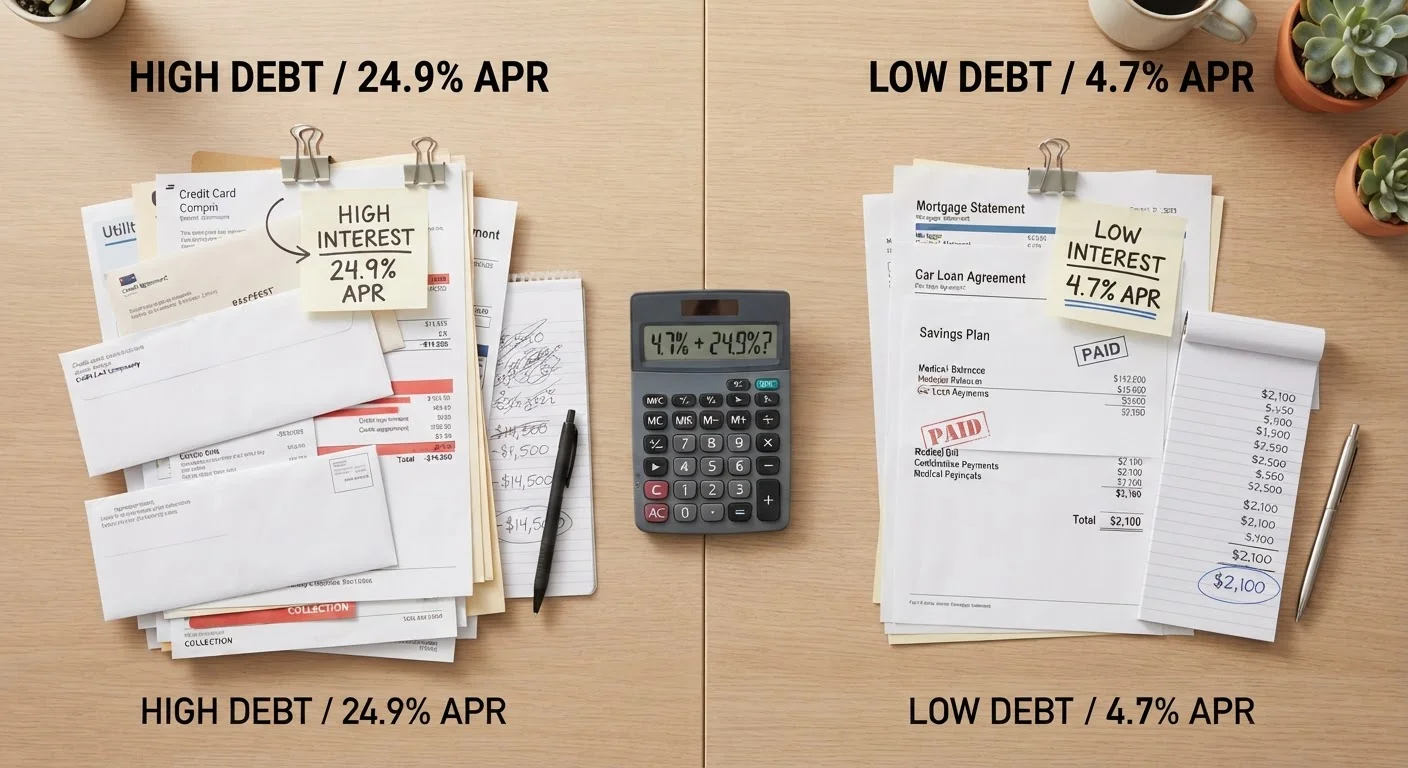
Photo credit: PrimeFaqs.com | Trending And Accurate Content
In this article
Not all debt is equally urgent. Learn how interest rates, loan types, and tax implications affect the order you should tackle your balances.
Key Takeaways
- High-interest debt costs more with each passing month, making it the general priority for aggressive repayment.
- Low-interest debt - such as mortgages or federal student loans - may carry tax deductions that change the true cost calculus.
- A small emergency fund should typically be in place before directing every extra dollar toward debt payoff.
- The mathematically optimal order and the psychologically sustainable order are not always the same - both matter.
- Tax-advantaged retirement contributions may outweigh the benefit of paying down low-interest debt early.
Why Interest Rate Is the Starting Point
When evaluating which debt to pay down first, the annual percentage rate (APR) - the yearly cost of borrowing expressed as a percentage - is the most direct signal of urgency. A higher APR means more of every payment goes toward interest rather than reducing the balance you actually owe.
Consider two balances of equal size: one at 22% APR (a common credit card rate) and one at 6% APR (a typical fixed-rate auto loan). Left unpaid for a year, the high-rate balance grows nearly four times faster in interest charges alone. That gap compounds over time, which is why the conventional guidance is to direct extra payments toward your highest-rate debt first - a method often called the debt avalanche. See how the debt avalanche compares to the debt snowball for a full breakdown of both approaches.
But APR is not the only number that matters. Tax deductibility, loan type, and your own financial stability all affect the calculation.
High-Interest Debt: The Case for Acting Fast
Credit cards, payday loans, and some private personal loans typically sit in the high-interest category - often 15% to 30% APR or higher. These debts share two characteristics that make them expensive to carry: they compound frequently (usually daily), and they offer no tax offset for the interest paid.
Paying only the minimum on a high-rate balance can extend repayment by years and multiply total interest paid dramatically. Minimum payments keep you in debt far longer than most borrowers realize - and the gap between the minimum and even a modest extra payment matters a great deal over time.
If you're carrying multiple high-interest balances, tools like a balance transfer card or personal loan may help consolidate them at a lower rate, though each option comes with its own trade-offs in fees and credit impact.
| High-Interest Debt | Low-Interest Debt | |
|---|---|---|
| Typical APR range | 15%-30%+ | 3%-8% |
| Common examples | Credit cards, payday loans | Mortgages, federal student loans, auto loans |
| Tax deductibility | Generally none | Often partially deductible (mortgage, student loan interest) |
| Urgency of extra payments | High - interest compounds quickly | Lower - slow growth, offset by deductions |
| Risk of carrying balance | High - can grow rapidly | Lower - manageable with steady payments |
| Competing financial priority | Few - paying down is almost always right | May be outweighed by employer match or investing |
Low-Interest Debt: When Slower Payoff Makes Sense
Mortgages, federal student loans, and many auto loans typically carry lower rates - often in the 3%-8% range - and some come with meaningful tax advantages. Mortgage interest, for instance, may be deductible for taxpayers who itemize, effectively reducing the real cost of carrying that debt. Federal student loan interest has historically offered its own deduction for qualifying borrowers.
When the after-tax cost of a loan is low - say, 4% effective rate - it may make more financial sense to direct extra cash toward tax-advantaged retirement accounts (which can offer growth and immediate tax savings) rather than accelerating payoff. If your employer matches 401(k) contributions, for example, passing that up to pay down a 4% loan likely leaves money on the table. That said, this comparison involves variables specific to your income, tax bracket, and risk tolerance, so consult a licensed financial adviser before making that call.
Federal student loan borrowers should also consider income-driven repayment options. Federal repayment plan options vary significantly in how they calculate payments and forgiveness timelines, which can affect whether aggressive payoff or managed repayment is smarter for your situation.
Calculate Your Effective After-Tax Rate
To compare low-interest debt against investment returns, calculate the effective after-tax interest rate. Multiply the loan rate by (1 minus your marginal tax rate) if the interest is deductible. For example, a 6% mortgage rate for someone in the 22% bracket has an effective rate of roughly 4.68%. That number is what you're actually paying - and what a competing investment would need to beat.
The Role of Savings in Your Repayment Order
A common mistake is directing every available dollar toward debt while keeping no liquid savings. If an unexpected expense arises - a car repair, a medical bill - a borrower with no buffer often turns back to a credit card, undoing recent progress at a high interest rate.
Most personal finance guidance recommends building at least a small emergency fund (commonly $1,000 to one month of expenses) before accelerating debt payoff beyond minimums. Once that floor is in place, extra cash can flow more confidently toward high-interest balances. Balancing debt repayment and emergency savings simultaneously is achievable with a deliberate, if modest, split of available cash.
Thinking about using existing savings to wipe out a balance entirely? Work through a checklist before draining savings to pay off debt - it may reveal factors that change your decision. A well-structured household budget is the foundation for making any of these decisions systematically rather than reactively.
This article provides general financial education and is not personalized financial, tax, or legal advice. Consult a qualified financial professional before making decisions about your specific debt and savings situation.

Author
Personal Finance Editorial Team
Personal Finance Editorial Team is the collective byline for our editorial team and contributor network. Articles published under this byline or an editorial pen name are researched, written, and reviewed according to our editorial standards for clarity, consistency, and independence before publication.
View all articles →