
Soil Health 101: What Your Garden Ground Is Actually Made Of
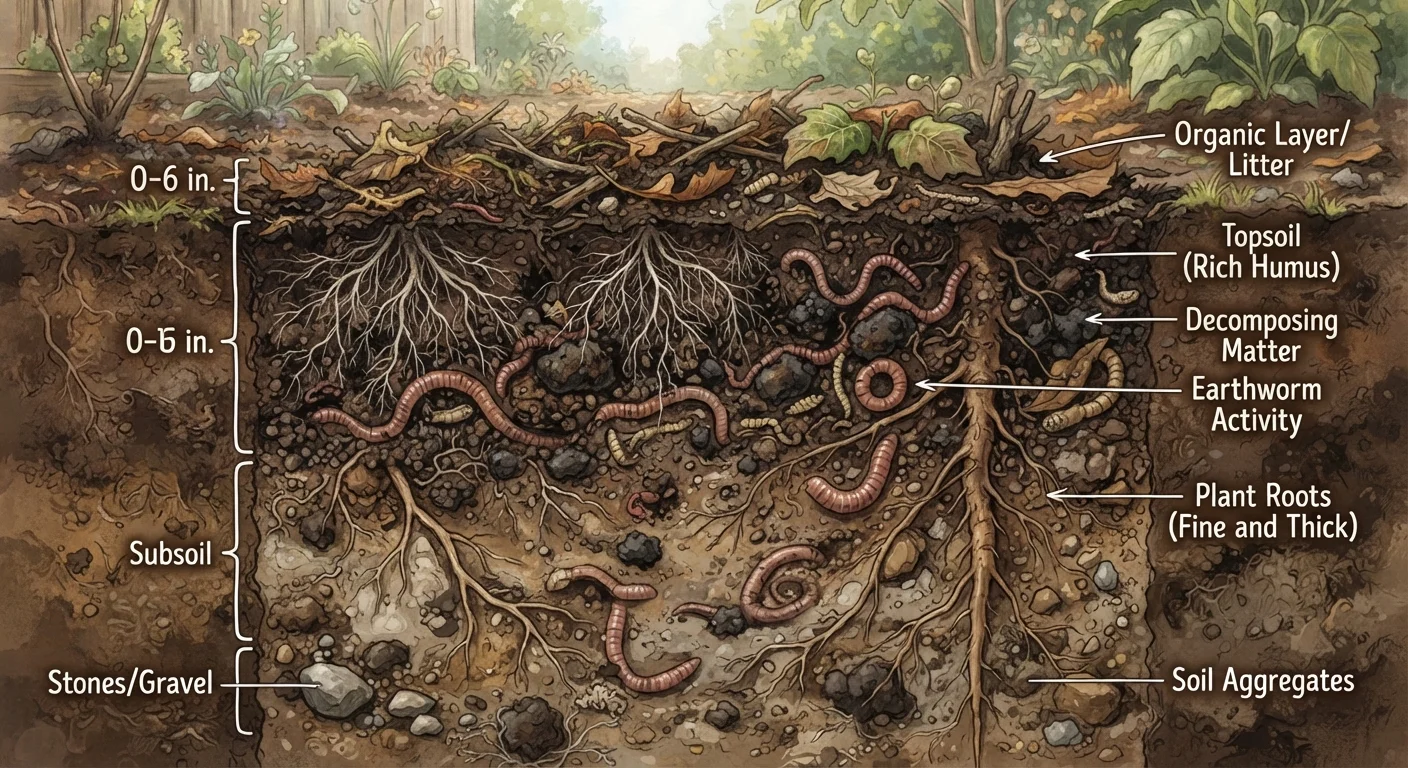
Photo credit: PrimeFaqs.com | Trending And Accurate Content
In this article
Understand the layers, nutrients, and biology that make up healthy garden soil — and why it matters more than any fertilizer you buy.
Key Takeaways
- Healthy soil is roughly 45% minerals, 25% water, 25% air, and 5% organic matter by volume.
- Soil texture - the ratio of sand, silt, and clay - determines drainage, aeration, and nutrient retention.
- Soil pH directly controls which nutrients plants can absorb, making it one of the most important factors to test.
- Organic matter improves nearly every soil property and feeds the microbial life plants depend on.
- Most garden soil problems can be addressed without expensive products - compost, mulch, and mindful management go a long way.
The Four Basic Ingredients of Garden Soil
Dig a handful of healthy garden soil and you're holding a remarkably complex material. Scientists generally describe soil as being composed of four components: minerals, organic matter, water, and air. The rough ideal for productive garden soil is about 45% mineral particles, 25% water, 25% air space, and 5% organic matter. That final 5% - organic matter - has an outsized influence on everything else.
Mineral particles form the skeleton of soil. They're categorized by size into three types: sand (largest), silt (medium), and clay (smallest). The ratio of these three determines your soil's texture - a fundamental property that affects how quickly water drains, how well roots penetrate, and how tightly nutrients are held. Loam, a roughly balanced mix of all three, is widely considered ideal for gardening because it combines good drainage with moisture and nutrient retention.
1 tsp
Bacteria in one teaspoon of healthy soil
Soil ecologists estimate a single teaspoon of productive soil may host hundreds of millions of bacterial cells, representing thousands of species.
5%
Organic matter in ideal garden soil
Though small by volume, organic matter drives water retention, nutrient cycling, and microbial activity - making it the most influential fraction of soil composition.
6.0-7.0
Optimal pH range for most vegetables
Within this slightly acidic to neutral range, the broadest spectrum of plant nutrients remains soluble and accessible to roots, according to standard soil science guidelines.
Air and water fill the pores between particles. Plants need both at the root zone - oxygen for cellular respiration and water to transport dissolved nutrients. Compacted soil collapses these pore spaces, starving roots of air and making drainage sluggish. This is why walking on garden beds can quietly damage even otherwise healthy soil.
The Living World Beneath Your Feet
What truly separates healthy garden soil from inert growing medium is biology. A single teaspoon of productive soil can contain hundreds of millions of bacteria, thousands of species of fungi, and a diverse cast of nematodes, protozoa, and arthropods. These organisms break down organic material into plant-available nutrients, suppress certain soil-borne pathogens, and help build the stable aggregates that give healthy soil its crumbly texture.
Mycorrhizal fungi are particularly important to understand. These microscopic fungi form cooperative relationships with plant roots, extending their reach far beyond what roots could explore alone. In exchange for sugars from the plant, the fungi deliver water and phosphorus. This network - sometimes called the wood wide web in popular science writing - can be disrupted by aggressive tilling, excess synthetic fertilizer, or fungicide use.
Protect Your Soil's Living Network
Minimize tilling whenever possible - even a single deep pass can sever fungal threads that took seasons to develop. When you do need to loosen soil, use a broadfork rather than a rotary tiller to lift and aerate without inverting layers. Building organic matter on the surface through compost and mulch works with soil biology rather than against it.
Earthworms are the most visible sign of a thriving soil ecosystem. They physically mix soil layers, improve drainage by creating channels, and produce castings that are rich in plant-available nutrients. A garden bed with abundant earthworm activity is generally a well-functioning one.
Soil Layers: Reading the Profile
Soil is not uniform from surface to bedrock. It develops distinct horizontal bands called horizons, each with different characteristics. For gardeners, the most relevant are the top two.
- Topsoil (O and A horizons): The uppermost layer, typically dark in color due to organic matter content. This is where most plant roots feed and where biological activity is highest. Its depth varies enormously - from a few inches in disturbed urban lots to over a foot in well-managed garden beds.
- Subsoil (B horizon): Lighter in color and denser, this layer has less organic matter and fewer organisms. Roots of larger plants penetrate here for water and anchorage, but it contributes little in terms of fertility.
Urban and suburban gardeners often start with topsoil that has been scraped, compacted, or mixed with construction fill during development. If your plants persistently underperform, a deeper look - literally digging down 12 to 18 inches - can reveal hardpan layers or poor subsoil masquerading as topsoil. This is especially worth checking before starting a vegetable garden from zero.
pH, Nutrients, and Why Balance Matters
Soil chemistry governs which nutrients plants can actually use. Soil pH - measured on a scale from 0 (extremely acidic) to 14 (extremely alkaline) - controls how nutrients bond to soil particles and whether roots can access them. Most garden plants prefer a pH between 6.0 and 7.0. Outside that range, nutrients like iron, manganese, or phosphorus can become chemically locked away, causing deficiency symptoms even when those nutrients are technically present in the soil.
The major plant nutrients - nitrogen (N), phosphorus (P), and potassium (K) - are what most fertilizer labels highlight. But calcium, magnesium, sulfur, and a suite of micronutrients (iron, zinc, boron, and others) are equally essential, just needed in smaller amounts. Organic matter and healthy biology help cycle all of these through the system naturally over time.
Before amending your soil with anything - lime to raise pH, sulfur to lower it, or additional nutrients - a proper soil test is worth the small investment. Extension services at land-grant universities across the country often offer low-cost testing. The results take the guesswork out of soil management and help you avoid over-applying amendments that can create new imbalances. Pairing smart soil care with good mulching practices can further protect soil structure and moisture year-round.
Where to Get a Soil Test
Many state cooperative extension services - connected to land-grant universities - offer affordable soil testing for homeowners, often for under $20. Results typically include pH, nutrient levels, and amendment recommendations tailored to your region. Search for your state's cooperative extension service to find a submission kit or local drop-off location.
Frequently Asked Questions

Author
Home & Garden Editorial Team
Home & Garden Editorial Team is the collective byline for our editorial team and contributor network. Articles published under this byline or an editorial pen name are researched, written, and reviewed according to our editorial standards for clarity, consistency, and independence before publication.
View all articles →