
Distracted Driving vs. Impaired Driving: How the Risks Compare
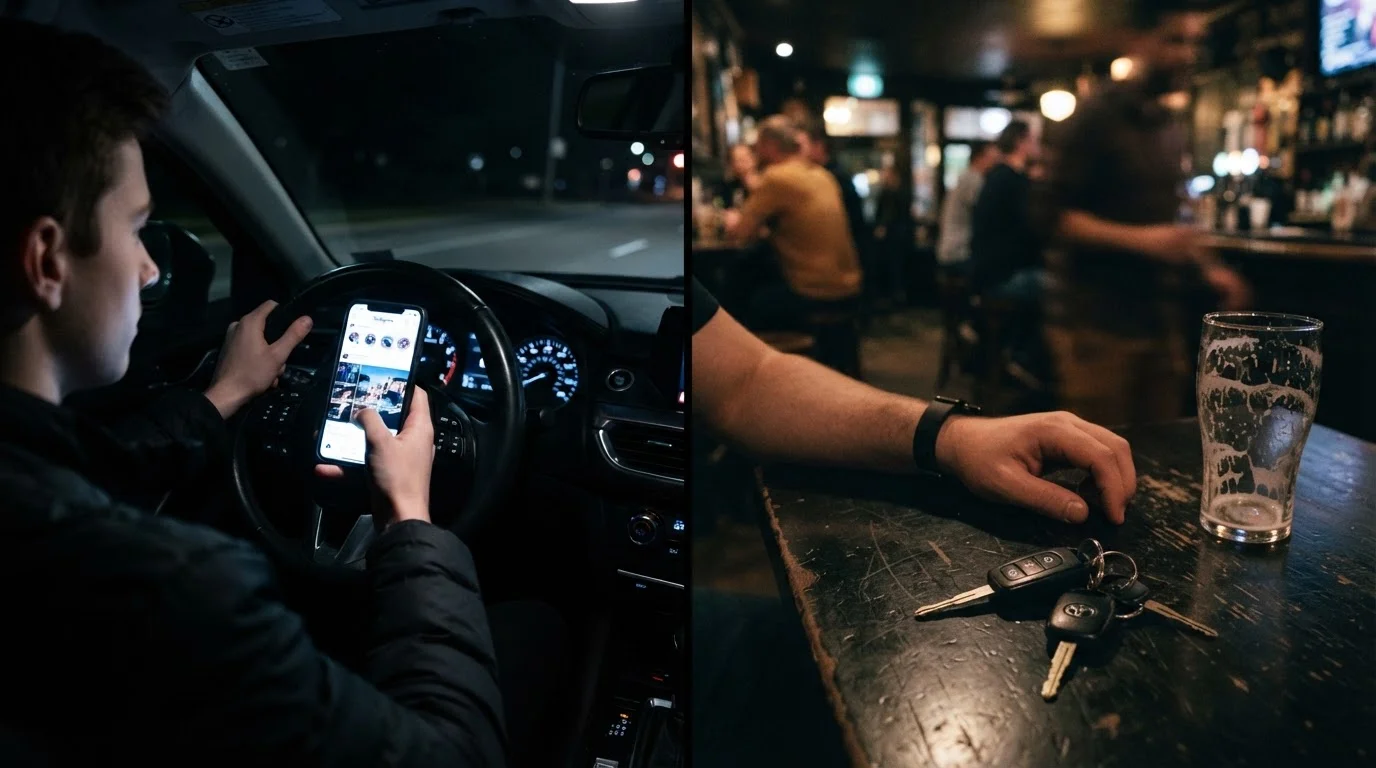
Photo credit: PrimeFaqs.com | Trending And Accurate Content
In this article
Both distracted and impaired driving significantly increase crash risk — but in different ways. See how each affects reaction time, judgment, and road safety.
Key Takeaways
- Distracted driving interrupts attention briefly but repeatedly, while impaired driving degrades overall cognitive function continuously.
- At 55 mph, glancing at a phone for 5 seconds covers the length of a football field without eyes on the road.
- Alcohol impairment can begin affecting judgment and coordination before a driver reaches the legal BAC limit of 0.08%.
- Both behaviors significantly increase crash risk and are leading contributors to traffic fatalities in the United States.
- Combining distraction and impairment compounds risk far beyond either factor alone.
- Practical strategies - like phone-free driving policies and planning ahead - can meaningfully reduce both risks.
How Each Type of Risk Works
Distracted driving and impaired driving both make roads more dangerous, but they undermine safety through different mechanisms. Understanding the distinction helps drivers recognize their own vulnerabilities - and take practical steps to address them.
Distracted driving occurs when a driver's attention is pulled away from the task of operating a vehicle. The National Highway Traffic Safety Administration (NHTSA) categorizes distractions into three types: visual (eyes off the road), manual (hands off the wheel), and cognitive (mind off driving). Sending a text message involves all three simultaneously, which is why it is considered one of the most dangerous driver behaviors. Even a five-second glance at a phone, at highway speeds, means traveling approximately the length of a football field without watching the road.
Impaired driving refers to operating a vehicle while one's ability is compromised by alcohol, illegal drugs, prescription medications, or other substances. Unlike distraction - which creates discrete gaps in attention - impairment degrades multiple functions at once and continuously: reaction time slows, peripheral vision narrows, coordination weakens, and the driver's ability to assess risk becomes unreliable. Critically, some degree of impairment can occur at blood alcohol concentrations (BAC) below the legal threshold of 0.08% in the U.S.
For a deeper look at how fatigue creates a parallel set of impairment-like risks, see our guide on driver fatigue.
| Criterion | Distracted Driving | Impaired Driving |
|---|---|---|
| Primary effect | Gaps in attention | Continuous cognitive & physical degradation |
| Driver self-awareness | Often aware they are distracted | Frequently unaware of how impaired they are |
| Common causes | Phones, passengers, eating, radio | Alcohol, drugs, certain medications |
| Reaction time impact | Delayed during distraction episode | Slowed continuously throughout drive |
| Legal threshold | Varies by state; handheld phone laws common | BAC 0.08% federal standard; lower for CDL/minors |
| Risk pattern | Episodic spikes in danger | Sustained elevated risk |
| Prevention approach | Habit change, device settings | Planning ahead, designated drivers |
The Real-World Impact on Crash Risk
Both behaviors contribute substantially to U.S. traffic deaths each year. According to NHTSA data, distracted driving was reported as a factor in thousands of fatal crashes annually, while alcohol-impaired driving accounted for roughly 30% of all traffic fatalities in recent reporting years - a figure that has remained persistently high over time.
~30%
Share of U.S. traffic fatalities involving alcohol impairment
According to NHTSA data, roughly 30% of all traffic crash deaths in the United States involve alcohol-impaired driving in recent reporting years.
5 sec
Average time eyes leave road during a text
NHTSA estimates that sending or reading a text takes a driver's eyes off the road for about five seconds - enough to travel the length of a football field at 55 mph.
0.05% BAC
BAC level at which driving skills begin to decline
Research indicates measurable impairment of steering and emergency response can begin at blood alcohol concentrations as low as 0.05%, below the U.S. legal limit of 0.08%.
What makes these numbers difficult to compare directly is how each risk plays out on the road. Distraction tends to be episodic: a driver is fully capable for most of a trip, then dangerously inattentive for a few seconds. Those seconds, however, can coincide with a pedestrian stepping off a curb or a vehicle braking suddenly ahead. Impaired driving, by contrast, affects every moment behind the wheel - including the driver's ability to recognize that their driving is deteriorating.
This self-awareness gap in impairment is particularly significant. Impaired drivers frequently overestimate their own capability, which reduces their likelihood of slowing down, pulling over, or avoiding risky maneuvers. Distracted drivers, in contrast, often know they are distracted - they simply underestimate how much that distraction matters.
Understanding either risk is also foundational to defensive driving principles, which help drivers anticipate the mistakes of others as well as their own.
Practical Steps to Reduce Both Risks
Awareness alone does not make roads safer - behavior change does. Here are concrete approaches for each type of risk.
Reducing Distraction
- Place your phone in Do Not Disturb mode or use a dedicated driving mode before starting the engine.
- Set navigation, music, and mirrors before moving - not while in motion.
- Pull over safely if you need to make a call, respond to a message, or look something up.
- Recognize that hands-free calling still creates cognitive distraction, even if your hands stay on the wheel.
Avoiding Impaired Driving
- Plan ahead: designate a driver, arrange a rideshare, or book accommodation before consuming alcohol or any substance that could impair you.
- Be aware that prescription and over-the-counter medications - including antihistamines, sleep aids, and some pain relievers - can impair driving ability. Consult your pharmacist or prescribing provider about driving safety when starting new medications.
- Never rely on coffee, food, or time alone to assess whether you are safe to drive after drinking. BAC and its effects are not reliably self-assessed.
Both categories of risk compound with others. Poor visibility at night, following too closely, or heavy traffic all increase the consequences of a lapse in attention or judgment. For more on how these hazards interact, see night driving hazards most drivers underestimate and building safer driving habits that actually stick.
Medications and Driving: An Overlooked Impairment Risk
Many drivers associate impaired driving exclusively with alcohol, but a wide range of legal medications - including antihistamines, muscle relaxants, opioid pain relievers, and some antidepressants - can significantly affect alertness, coordination, and reaction time. The impairment risk from medications is often underestimated because the substances are prescribed or available over the counter. Always read medication labels for driving-related warnings, and speak with a healthcare provider or pharmacist if you are unsure whether a medication affects your ability to drive safely.

Author
Automotive Basics Editorial Team
Automotive Basics Editorial Team is the collective byline for our editorial team and contributor network. Articles published under this byline or an editorial pen name are researched, written, and reviewed according to our editorial standards for clarity, consistency, and independence before publication.
View all articles →