
Home Insulation Types and Where Each One Actually Belongs
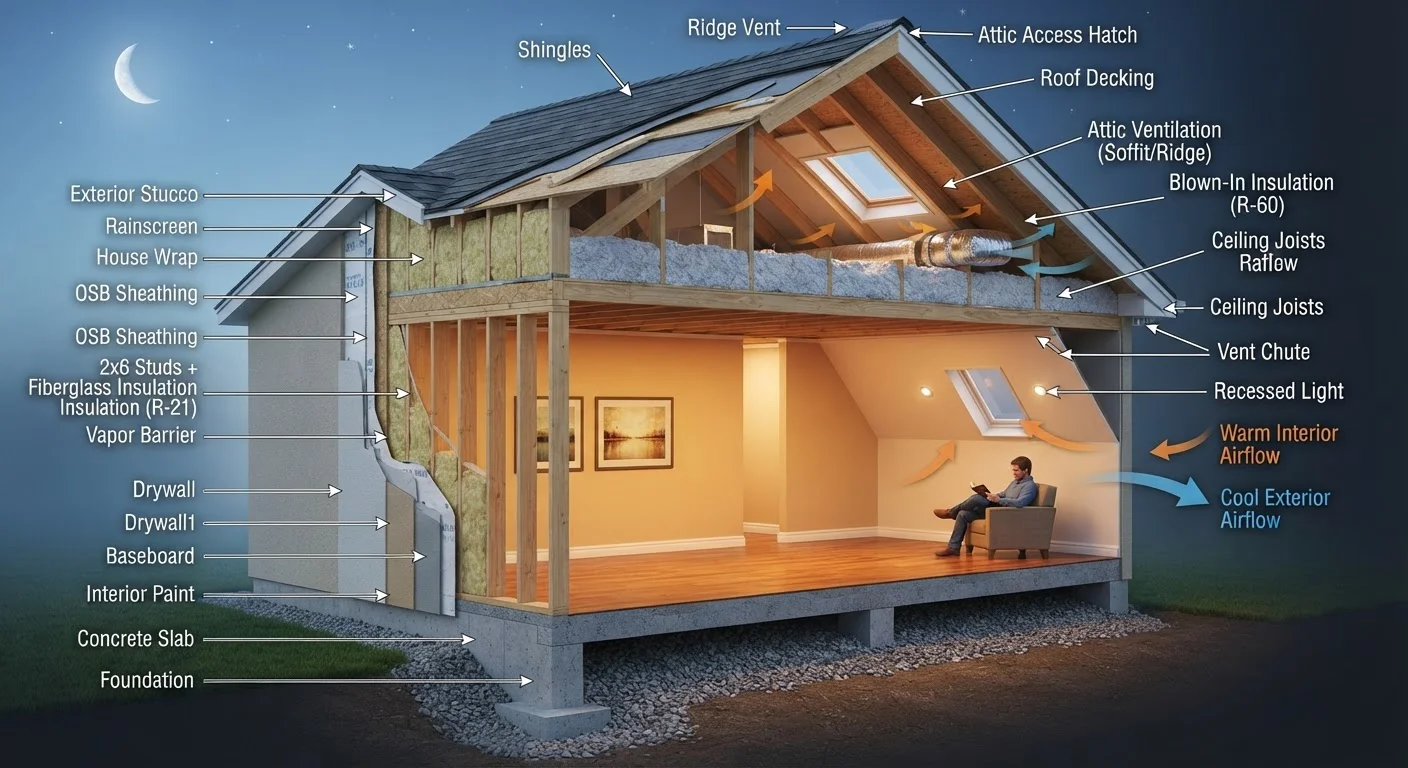
Photo credit: PrimeFaqs.com | Trending And Accurate Content
In this article
Batts, blown-in, spray foam, and rigid board all serve different roles. A clear breakdown of insulation materials, R-values, and appropriate application zones.
Key Takeaways
- R-value measures insulation's resistance to heat flow - higher values mean better thermal performance.
- No single insulation type suits every location; matching material to application zone matters significantly.
- Spray foam is effective for air sealing but typically requires professional installation for safety.
- Attics, crawl spaces, walls, and basements each have distinct moisture and temperature profiles requiring different materials.
- Local building codes often specify minimum R-values - always verify requirements before starting a project.
Choosing the Right Insulation Starts With Knowing the Zone
Homeowners often treat insulation as a single category - something you add more of when the house feels drafty. In practice, insulation materials have distinct physical properties that make each one more effective in certain locations and less appropriate in others. The wrong material installed in the wrong place can trap moisture, compress underfoot, or fail to meet code minimums - all costly outcomes.
The organizing principle is simple: consider the moisture exposure, temperature range, structural format, and fire safety requirements of each zone, then match the insulation accordingly. R-value matters too, but it's only one variable.
Understanding R-Value and Climate Zones
R-value measures thermal resistance - how well a material slows heat transfer. The U.S. Department of Energy divides the country into climate zones with recommended minimum R-values for attics, walls, floors, and crawl spaces. A home in Minnesota requires significantly higher R-values than one in Florida. Before purchasing materials, look up your climate zone's recommendations and cross-reference with local building code minimums, which may differ.
The list below covers the five most common insulation types found in American homes, where each genuinely belongs, and the practical constraints installers and homeowners should keep in mind.
Five Insulation Types and Their Proper Applications
Fiberglass Batts - The Go-To for Framed Walls and Attic Floors
Fiberglass batts are the most widely recognized insulation material in American homes, and for good reason. Pre-cut to fit standard 16- or 24-inch stud spacing, they slide neatly into open wall cavities, floor joists, and attic floors with minimal tools. R-values typically range from R-11 to R-38 depending on thickness.
They perform best in dry, enclosed cavities where they won't be compressed or exposed to persistent moisture. Compression significantly reduces their effectiveness - a batt rated R-19 stuffed into a space designed for R-13 will underperform both. Always install batts at the correct thickness for the cavity depth, and use faced batts (with kraft paper or foil) when a vapor retarder is needed, particularly in cold climates.
Attic floors are a strong application: lay batts between joists, then run a second layer perpendicular across the top for continuous coverage. Avoid using standard batts in basement rim joists or areas prone to humidity without additional protective measures.
Compression kills performance - always match batt thickness to cavity depth exactly.
Blown-In (Loose-Fill) Insulation - Ideal for Attics and Hard-to-Reach Spaces
Blown-in insulation - available in fiberglass or cellulose - is installed using a blower machine that allows the material to settle into irregular cavities, around obstructions, and over existing attic insulation without major disruption. Cellulose, made largely from recycled paper treated with fire retardants, is particularly popular for topping up existing attic insulation.
This material excels in open attic decks, enclosed existing walls via drill-and-fill methods, and floors over unconditioned spaces. Because it conforms to whatever space it fills, it covers gaps that batts would bridge over - reducing hidden air leakage points. Settling over time is a real consideration: cellulose can settle 15-20%, so installers typically add extra depth to compensate.
Renting a blower machine from a home improvement retailer is feasible for attic applications, but drill-and-fill wall installations require more skill and are often better left to experienced contractors to avoid inadequate coverage.
Blown-in cellulose conforms around obstructions, covering gaps that rigid batts routinely miss.
Spray Foam - The Air Sealing Champion for Rim Joists, Gaps, and Crawl Spaces
Spray polyurethane foam (SPF) comes in two main types: open-cell (lower density, vapor-permeable, around R-3.5 per inch) and closed-cell (denser, moisture-resistant, around R-6 to R-7 per inch). The key advantage of either type is that it expands on contact, sealing air gaps and providing insulation simultaneously - something no other material does as thoroughly.
Closed-cell spray foam is particularly well-suited for basement rim joists, crawl space walls, rooflines in conditioned attics, and areas with moisture exposure risk. Open-cell foam works well for interior wall cavities when air sealing is the primary goal and vapor management is handled separately.
Important: Professional-grade two-component spray foam involves chemical off-gassing during installation. Licensed insulation contractors use proper protective equipment, and occupants should vacate during application and follow re-entry guidelines provided by the installer. Small single-component cans are fine for sealing gaps around pipes and windows, but large-scale applications require professional handling.
Closed-cell spray foam offers the highest R-value per inch and doubles as a moisture barrier.
Rigid Foam Board - For Foundations, Exterior Sheathing, and Below-Grade Walls
Rigid foam boards - including expanded polystyrene (EPS), extruded polystyrene (XPS), and polyisocyanurate (polyiso) - offer consistent R-values (roughly R-3.8 to R-6.5 per inch depending on type) without the air gaps inherent in batt installations. Because they're solid panels, they can be cut precisely and layered to achieve target R-values.
These boards are the insulation of choice for exterior foundation walls, under concrete slabs, exterior wall sheathing, and basement interior walls. XPS performs especially well in below-grade applications where moisture contact is likely, as it resists water absorption better than EPS. Polyiso boards are common on rooftops and exterior sheathing applications but can lose some rated R-value in very cold temperatures - a factor worth discussing with a contractor in northern climates.
When installing rigid foam on basement walls, local fire codes typically require covering it with a thermal barrier such as drywall. Verify requirements with your local building department before leaving rigid foam exposed.
XPS rigid foam resists moisture absorption, making it the right choice for below-grade foundation walls.
Mineral Wool (Rockwool/Slag Wool) - Fire Resistance and Moisture Tolerance
Mineral wool, sold as rock wool or slag wool, is manufactured from natural rock or industrial slag spun into fibers. It shares the batt format with fiberglass but offers meaningful performance differences: it is naturally fire-resistant (standing up to temperatures above 1,000°F), hydrophobic (it sheds water rather than absorbing it), and provides slightly better soundproofing than comparable fiberglass batts.
These properties make mineral wool well-suited for garage walls adjacent to living spaces, utility rooms, areas around fireplaces, basement walls, and any location where moisture intrusion or fire spread is a concern. Its density also gives it a slight edge in soundproofing between floors and rooms - useful in multi-story homes or home office conversions.
Mineral wool batts are typically denser and easier to cut cleanly than fiberglass, and they hold their shape without support during installation. R-values are comparable to fiberglass batts at the same thickness, so application zone - not thermal performance differences - is usually the deciding factor when choosing between the two.
Mineral wool's hydrophobic properties make it a reliable choice wherever moisture exposure is a concern.
Pair Insulation with Air Sealing
Insulation slows heat transfer, but air leaks bypass it entirely. Before adding or replacing insulation - especially in attics - seal gaps around light fixtures, plumbing penetrations, and top plates with caulk or expanding foam. This two-step approach consistently delivers better energy performance than insulation alone.
Putting It All Together
Most homes use a combination of insulation types - not because one product was unavailable, but because different zones genuinely demand different solutions. A well-insulated home might have blown-in cellulose in the attic, closed-cell spray foam at the rim joists, fiberglass batts in interior walls, and rigid XPS board lining the basement foundation.
For straightforward attic and wall batt installations, experienced DIYers can often handle the work themselves with proper preparation. For spray foam beyond small cans, below-grade work, or anything involving electrical, structural, or gas systems, consulting a licensed insulation contractor or building professional is the responsible path. Always pull required permits and confirm local R-value requirements with your building department before work begins - codes vary by municipality and are updated periodically.
If you're improving other areas of your home exterior, the same zone-matching logic applies in the garden. See our guide to garden mulch types and uses for a similar breakdown of how material selection shapes real-world results.

Author
Home & Garden Editorial Team
Home & Garden Editorial Team is the collective byline for our editorial team and contributor network. Articles published under this byline or an editorial pen name are researched, written, and reviewed according to our editorial standards for clarity, consistency, and independence before publication.
View all articles →