
Play-Based Learning Across the Early Childhood Years
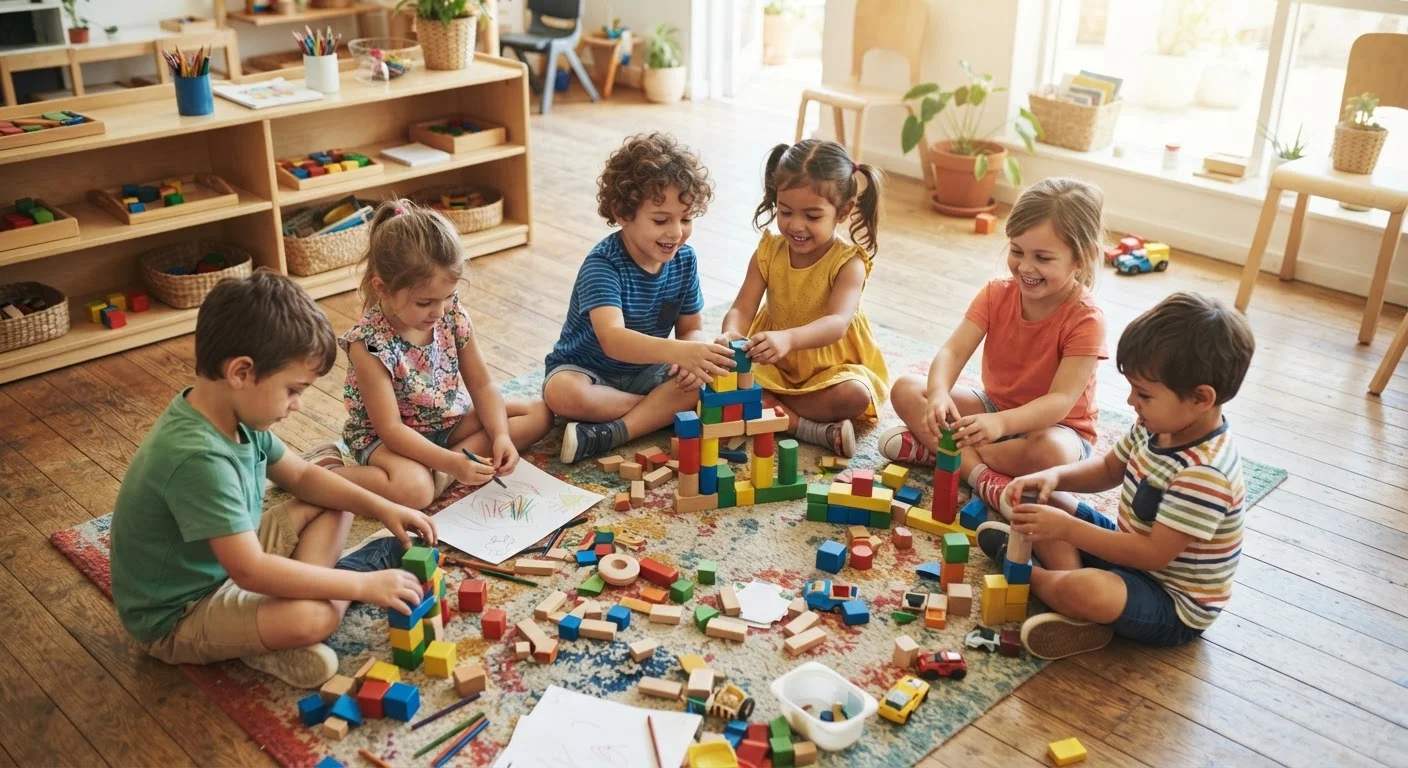
Photo credit: PrimeFaqs.com | Trending And Accurate Content
In this article
From free play to structured games, learn how different types of play build cognitive, social, and language skills in young children.
Key Takeaways
- Play is the primary mechanism through which young children build cognitive, language, and social-emotional skills.
- Different types of play - free, guided, and structured - each contribute distinct developmental benefits.
- Parents have a meaningful role as play supporters without needing to manage or direct children's activities.
- Play's benefits extend across the full early childhood window, from infancy through age eight.
- Screen-based play is not equivalent to hands-on, interactive play for most developmental outcomes.
What Play-Based Learning Actually Means
Play-based learning refers to educational experiences in which children acquire knowledge and skills through play - activities they find engaging, self-motivated, and intrinsically rewarding. It is not the same as simply letting children do whatever they want, nor is it the opposite of academic learning. Rather, it is a recognition that for children in the early childhood years (roughly birth through age eight), play is the most effective mode of learning available.
Developmental scientists use the term broadly to encompass a spectrum from free play - entirely child-directed, with no adult agenda - to guided play, in which an adult establishes an environment or lightly frames an activity, and structured games with explicit rules. Each type occupies a legitimate place in a young child's day.
The research basis is deep. Decades of work in developmental psychology, neuroscience, and educational research converge on the finding that play activates the same neural circuits involved in memory, language acquisition, problem-solving, and emotion regulation. Understanding why play works helps parents make intentional choices about how to support it - rather than viewing it as something to be squeezed in between "real" learning.
Play Is Not a Luxury - It Is a Right
The United Nations Convention on the Rights of the Child explicitly recognizes play as a fundamental right of every child. Reducing or eliminating play time in favor of academic drilling - especially before age six - is not supported by developmental science and may undermine the very skills formal schooling depends on, including attention, persistence, and problem-solving.
Types of Play and What Each One Builds
Not all play looks the same, and different forms produce different developmental benefits. Recognizing these categories helps parents understand what they are observing and how to support each type.
Free Play
Child-directed, spontaneous, and undirected by adults. During free play, children set their own goals, negotiate rules with peers, recover from frustration, and practice creative thinking. Research links generous free play time to stronger executive function - the cluster of skills that includes focus, impulse control, and flexible thinking.
Pretend and Symbolic Play
When a toddler uses a banana as a phone or a preschooler becomes a dragon, they are engaged in symbolic play - using one thing to represent another. This capacity for abstraction is a cognitive forerunner to reading and mathematics, both of which require understanding that symbols (letters, numerals) stand for something else.
Constructive Play
Building with blocks, creating with clay, assembling puzzles - constructive play is the most common form among preschool-age children. It builds spatial reasoning, fine motor skills, and early engineering thinking.
Games With Rules
Board games, card games, and organized outdoor games introduce children to rule-following, turn-taking, winning, losing, and strategic thinking. These become increasingly central from age five onward.
75%
Brain development completed by age 3
According to the Harvard Center on the Developing Child, roughly 90% of brain architecture is established by age 5, with rapid development beginning at birth.
2-3x
Vocabulary growth advantage with rich play environments
Research published in developmental psychology journals consistently shows that children in language-rich, play-centered settings demonstrate substantially faster vocabulary acquisition.
Age 3-5
Peak window for imaginative and pretend play
Child development researchers identify the preschool years as the period when symbolic and pretend play is most elaborate and cognitively demanding.
Sensory and Physical Play
Digging in dirt, splashing in water, and climbing on play structures build body awareness, sensory integration, and gross motor development. Physical play is also consistently linked to improved attention in classroom settings.
Play Across the Early Childhood Stages
Play evolves considerably between infancy and age eight. Understanding the trajectory helps parents offer appropriately matched experiences at each stage.
Infants (Birth-12 Months)
For infants, play is primarily sensory and relational. Peek-a-boo, responsive cooing, reaching for objects, and exploring textures are all forms of play that build the foundations of object permanence, attachment, and cause-and-effect thinking. Face-to-face interaction with a caregiver is arguably the most powerful play environment available to a young baby.
Toddlers (1-3 Years)
Toddlers move rapidly from solitary and parallel play (playing alongside, not yet with, other children) toward early cooperative play. Pretend play emerges around 18 months. Language and play are deeply intertwined during this period - narrating play, asking open-ended questions, and providing vocabulary in context all accelerate development simultaneously.
Preschoolers (3-5 Years)
Pretend play becomes elaborate and collaborative. Children negotiate roles, construct narratives, and sustain complex imaginative scenarios - cognitively demanding work dressed up as fun. This is also when the foundations of early literacy and numeracy can be meaningfully woven into play through books, songs, counting games, and storytelling. See our companion piece on how reading aloud versus independent reading each support young learners.
Early School Age (6-8 Years)
Children in this stage begin integrating structured games and rule-based play more fully. Play continues to be essential, though it increasingly intersects with formal academic instruction. Families who want to maintain momentum through school breaks can explore research-backed strategies for preventing summer learning loss without abandoning play.
“Play is the work of childhood. Through play, children learn about their world, develop language, and practice the social skills they will use for the rest of their lives.”
— Fred Rogers, Educator and children's television creator
How Parents Can Support Play Without Directing It
Research distinguishes between adults who enrich play environments and those who take over play. The former is associated with developmental gains; the latter can undermine children's agency, creativity, and intrinsic motivation.
Create the Conditions
Provide open-ended materials: blocks, art supplies, natural objects, dress-up clothes, and simple household items. These sustain more varied and longer play than single-purpose toys. Protect unscheduled time - children need boredom to access imagination.
Keep the Play Environment Simple and Rotating
Offering too many toys at once can overwhelm children and shorten play duration. Rotating a smaller set of open-ended materials - blocks, art supplies, loose natural objects - every week or two tends to spark richer, longer play sessions. Open-ended materials also support more types of play across a wider age range.
Observe Before Intervening
Before stepping in, watch what your child is actually doing. Many behaviors that look like conflict or confusion are children working through problems independently - a critical skill in itself.
Use Language That Extends Thinking
When you do join play, ask genuine questions rather than directing: "I wonder what would happen if..." or "How could we make this taller?" These prompts support thinking without hijacking the child's agenda.
Follow the child's lead during play - resist the urge to correct or redirect unless safety is a concern. Children learn more deeply when they maintain agency over the activity.
Research on self-directed play consistently shows that intrinsic motivation drives longer engagement and better retention of concepts discovered during play.
Narrate what your child is doing during play without turning it into a lesson. 'You're stacking the tall ones first - now the tower is really high!' builds vocabulary and thinking without disrupting the flow.
This technique, sometimes called 'sportscasting,' expands language exposure in a naturalistic context, which developmental linguists link to stronger early literacy outcomes.
When Play Intersects With Other Learning Approaches
Play-based learning does not exist in isolation. Parents and educators frequently encounter questions about how it relates to other practices - including screen use, language development in multilingual households, and formal instruction.
On screens: digital media can include interactive, playful elements, but they are generally not equivalent to hands-on, embodied play for most developmental outcomes. The quality of digital interaction matters significantly. Our article on passive versus active screen engagement explores how to evaluate what children are actually doing - and gaining - during digital time.
On language: for children growing up in multilingual households, play in any language builds cognitive flexibility and vocabulary. The research on bilingual development consistently finds play-rich environments beneficial regardless of the language in use.
On memory and retention: the learning that happens during play is consolidated through the same mechanisms that govern all learning - practice, sleep, and repetition. Understanding how children retain new information provides helpful context for why playful repetition (singing the same song, reading the same book) is so effective.
Play Looks Different for Every Child
Temperament, sensory preferences, and developmental stage all shape how a child plays. A child who prefers solitary, quiet play is not necessarily behind socially - parallel and solitary play are normal and developmentally appropriate well into the preschool years. See our guide on what developmental milestones actually measure for more context on interpreting your child's development.
Common Questions From Parents
"My child's preschool uses a lot of play. Is my child actually learning anything?"
Yes - almost certainly more than they would in a highly didactic (teacher-directed, instruction-heavy) environment at this age. The evidence for play-based early childhood programs on long-term outcomes - including school readiness, executive function, and social competence - is substantially stronger than for drill-and-practice approaches in the early years.
"How much free play is enough?"
There is no single prescription, but the American Academy of Pediatrics recommends that all children have daily opportunities for free, unstructured play. For young children, this means at minimum one to two hours daily, though more is supported by the evidence. Structured activities and academic instruction can complement - but should not consistently replace - that time.
"My child has a learning difference. Does play-based learning still apply?"
Generally, yes, though the specific supports and adaptations may differ. Play is especially valuable for children who find traditional instruction difficult, because it provides low-pressure opportunities to practice language, social skills, and problem-solving. Consult with your child's evaluation team for individualized guidance. Our guide on supporting a child with a learning difference covers how to navigate that process.
Overscheduling Can Crowd Out Essential Free Play
Back-to-back enrichment activities leave little room for unstructured time, which children need to practice self-regulation and creative thinking. Pediatric health organizations, including the American Academy of Pediatrics, have noted a decline in children's free play time alongside rising rates of childhood anxiety. Protecting at least some daily unscheduled time is as developmentally important as any organized activity.

Author
Education & Learning Editorial Team
Education & Learning Editorial Team is the collective byline for our editorial team and contributor network. Articles published under this byline or an editorial pen name are researched, written, and reviewed according to our editorial standards for clarity, consistency, and independence before publication.
View all articles →