
What Your Blind Spots Actually Cover - and How to Account for Them
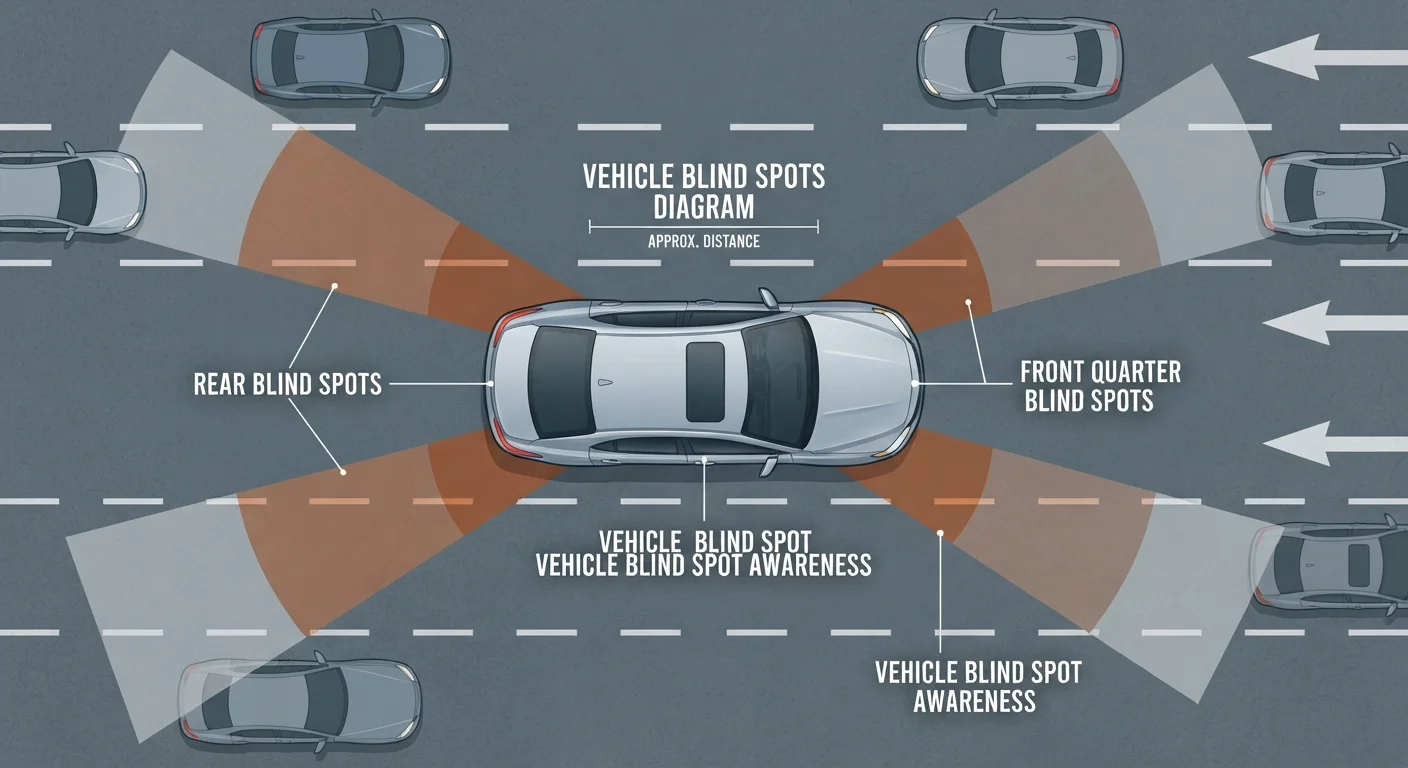
Photo credit: PrimeFaqs.com | Trending And Accurate Content
In this article
Blind spots are larger than most drivers realize. Understand where they fall around your vehicle and the habits that keep them from becoming a hazard.
Key Takeaways
- Blind spots exist on all four sides of your vehicle, not just the rear quarters.
- Trucks, SUVs, and vans have significantly larger blind zones than sedans.
- Mirrors alone cannot eliminate blind spots - physical head checks are necessary.
- Proper mirror adjustment reduces blind spot size but does not eliminate it entirely.
- Maintaining adequate following distance helps you stay out of other drivers' blind spots too.
The Geometry of What You Can't See
Most drivers understand that blind spots exist, but fewer have a precise mental picture of where they fall. The reality is more expansive than a quick glance in the mirrors suggests.
On a typical passenger sedan, the primary blind zones sit on both rear quarters - roughly from the B-pillar (the roof support between your front and rear side windows) rearward to just past the rear bumper. These are the zones most lane-change collisions involve. But the full map doesn't stop there.
- A-pillar blind spots: The angled front roof supports can hide cyclists, pedestrians, or vehicles approaching from a diagonal - especially at intersections.
- Rear center zone: The area directly behind your vehicle, blocked by the trunk or cargo area, is invisible without a backup camera or rearview mirror (and mirrors can't show everything at low, close distances).
- Hood blind zone: The area directly in front of the hood - most critical for detecting small children or low obstacles in driveways or parking lots.
Larger vehicles expand all of these zones considerably. A full-size pickup truck or SUV can have rear blind zones that extend 10 to 20 feet behind the vehicle - a range wide enough to fully conceal a small car at close range.
~28%
Of lane-change crashes involve blind spot failures
The National Highway Traffic Safety Administration has consistently identified failure to check blind spots as a leading contributing factor in sideswipe and lane-change collisions.
10-20 ft
Rear blind zone depth on full-size trucks and SUVs
Vehicle safety researchers have measured rear blind zones on larger vehicles that can extend well beyond what most drivers estimate, underscoring the importance of backup cameras.
~840,000
Annual U.S. crashes attributed to blind spot issues
Industry safety research, including data referenced by the Insurance Institute for Highway Safety, links hundreds of thousands of crashes each year to inadequate blind spot checking.
Why Mirror Adjustment Matters - and Its Limits
Many drivers set their side mirrors to show a wide slice of their own vehicle along the inner edge. This is a natural instinct - it feels like an anchor point - but it wastes a significant portion of the mirror's coverage area. A more effective adjustment points the mirror farther outward, so your own car is just barely visible at the inner edge.
When done correctly on both sides, this creates a better overlap between your mirror view and your peripheral vision, shrinking the gap between what the mirror sees and what a shoulder check catches. The Society of Automotive Engineers has studied various mirror positioning methods, and outward-angled positions consistently reduce the angular size of rear-quarter blind zones.
That said, no mirror setup eliminates the blind spot entirely. The geometry of the human eye, mirror placement constraints, and vehicle structure mean there will always be a gap. Head checks - physically turning your head to look over your shoulder before lane changes - remain the reliable backstop.
A Simple Mirror Check Before Every Trip
Before pulling out of a parking spot or driveway, take five seconds to confirm your side mirrors are properly angled - your own vehicle should be just barely visible at each inner edge. Mirrors shift over time, especially if others drive your vehicle. Making this a quick pre-drive habit costs almost nothing and keeps your coverage consistent.
Habits That Close the Gap
Knowing where blind spots fall is only useful if that awareness translates into consistent habits. A few practical routines make a meaningful difference:
- Check mirrors before you need them. Glancing at mirrors every 5-8 seconds keeps your mental picture of surrounding traffic current, so you're not reconstructing the picture from scratch when you need to merge.
- Always pair a mirror check with a shoulder check. Before any lane change, look in your mirror first to get a picture of the lane, then briefly check over your shoulder to confirm nothing is hiding in the blind zone. The shoulder check takes under a second.
- Signal early. Signaling before you check gives other drivers time to adjust their position, potentially clearing the space you need. It also gives them a heads-up if you don't yet see them.
- Don't linger in other drivers' blind spots. On highways, aim to be clearly in front of or behind other vehicles rather than alongside them. If you can't see a truck driver's face in their mirror, assume they can't see you.
These habits complement each other, and over time they become automatic. For a broader look at how consistent behavior builds on itself, see building safer driving habits that actually stick.
Technology Helps - But Doesn't Replace Awareness
Blind spot monitoring systems, rear cameras, and parking sensors have made a real difference in crash prevention. Blind spot monitoring typically uses radar or cameras to detect vehicles in adjacent lanes and alerts the driver - usually with a light in the mirror or an audible tone - when a lane change would be hazardous.
These systems are valuable, but they have documented limitations. They may not detect cyclists or motorcycles reliably, can be less effective at low speeds, and are sometimes triggered by guardrails or stationary objects. Treating them as a supplement to good habits rather than a replacement for them keeps you better protected.
Night driving adds another layer of complexity, since reduced visibility can extend the effective range of blind zones. Our article on night driving hazards most drivers underestimate covers how darkness changes the driving equation in ways that go beyond blind spots alone.
Understanding blind spots is part of the larger picture of responsible car ownership - knowing your vehicle's limitations and managing them consistently. For a grounded look at other ownership realities, the Car Ownership hub covers everything from insurance decisions to everyday vehicle choices.
Frequently Asked Questions

Author
Automotive Basics Editorial Team
Automotive Basics Editorial Team is the collective byline for our editorial team and contributor network. Articles published under this byline or an editorial pen name are researched, written, and reviewed according to our editorial standards for clarity, consistency, and independence before publication.
View all articles →