
Hard Inquiries vs. Soft Inquiries: What Actually Affects Your Credit
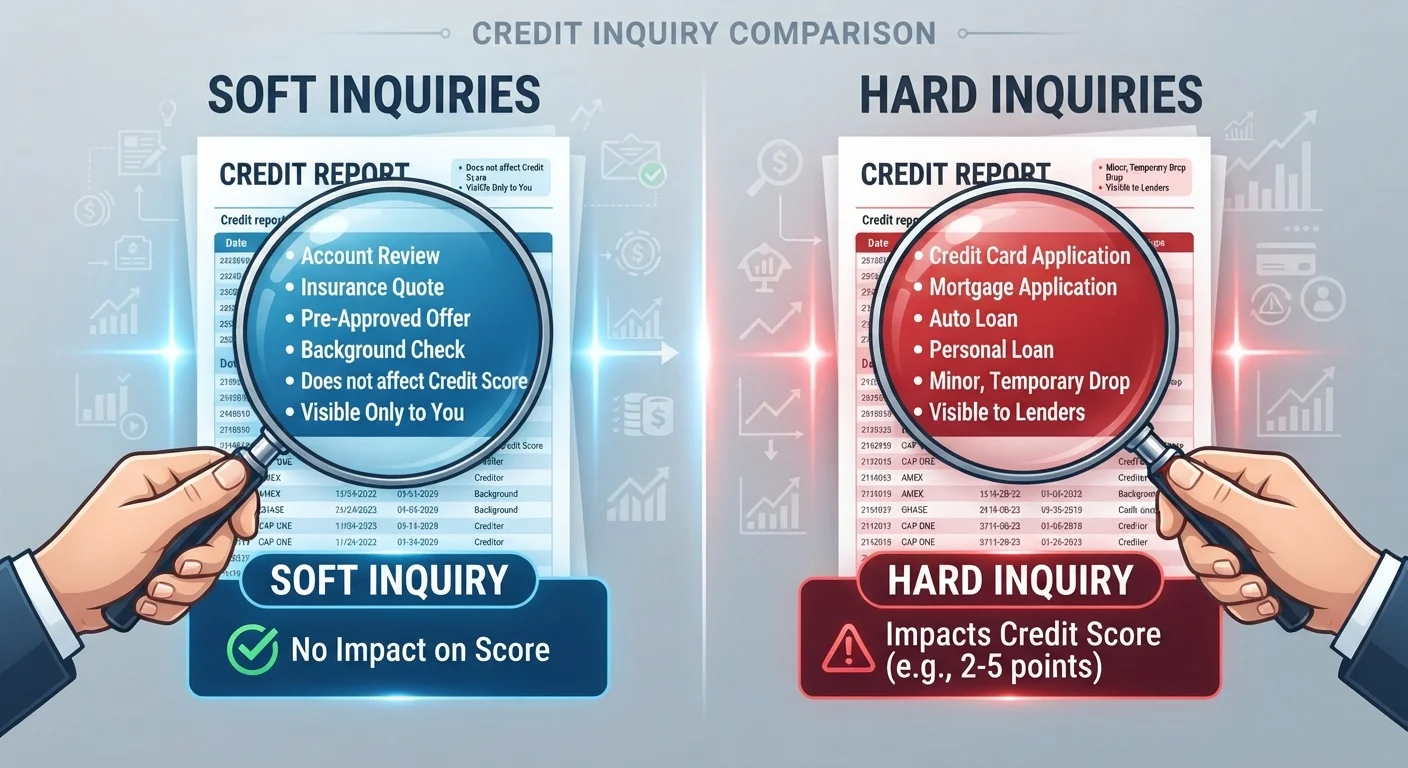
Photo credit: PrimeFaqs.com | Trending And Accurate Content
In this article
Not all credit checks are equal. Understand the difference between hard and soft pulls, how long each stays on your report, and when to care.
Key Takeaways
- Hard inquiries occur when you apply for credit and can temporarily lower your score by a few points.
- Soft inquiries - including checking your own credit - have zero effect on your credit score.
- Hard inquiries remain on your credit report for two years but typically affect scoring for only 12 months.
- Multiple hard inquiries for the same loan type within a short window are often counted as a single inquiry by scoring models.
- You cannot control whether a lender pulls a hard or soft inquiry - the type depends on the purpose of the check.
What Makes an Inquiry Hard or Soft
A credit inquiry is simply a record of who accessed your credit report and why. The distinction between hard and soft comes down to purpose and permission.
A hard inquiry (also called a hard pull) happens when a lender, creditor, or financial institution reviews your full credit report as part of evaluating a formal application - for a credit card, mortgage, auto loan, personal loan, or even some apartment rentals. You must authorize this type of access, and it is recorded on your report in a way that scoring models can see.
A soft inquiry (soft pull) occurs in lower-stakes situations: when you check your own credit, when a lender pre-screens you for a promotional offer, or when an employer or landlord runs a background check. Soft inquiries are recorded on your report, but only you can see them - they are invisible to other lenders and ignored entirely by credit scoring formulas.
| Criterion | Hard Inquiry | Soft Inquiry |
|---|---|---|
| Triggered by | Formal credit applications | Self-checks, pre-approvals, background screens |
| Score impact | Yes - typically small, temporary drop | None whatsoever |
| Visible to other lenders | Yes | No - only visible to you |
| Stays on report | 2 years | May appear on your copy; not on lender-facing report |
| Counts in scoring models | Up to 12 months | Never counted |
| Requires your authorization | Yes | Generally not required for pre-screens |
| Rate-shopping protection | Yes, for mortgage/auto/student loans | N/A - no impact to protect against |
To understand how inquiries fit into the broader picture of what shapes your score, see our article on what your credit score actually measures.
How Hard Inquiries Affect Your Score - and for How Long
Hard inquiries are a factor in the "new credit" category of FICO scoring, which accounts for roughly 10% of your total score. In practice, a single hard inquiry typically causes a drop of fewer than five points for most consumers - a modest, temporary effect.
There are two important timelines to keep straight:
- On your report: Hard inquiries remain visible for two years from the date of the pull.
- On your score: Most scoring models stop counting hard inquiries against you after 12 months - so the second year is purely informational for lenders reviewing your history, not a scoring penalty.
Credit Inquiries Are a Minor Scoring Factor
New credit inquiries account for approximately 10% of a FICO score, making them far less influential than payment history (35%) or credit utilization (30%). A single hard inquiry rarely changes a lending decision on its own. However, a cluster of unrelated hard inquiries in a short period can signal elevated risk to lenders reviewing your full application profile - not just your score.
The exception to worry about is applying for several different types of credit in a short span - a credit card, a personal loan, and a car loan all within a few weeks. Each represents a separate inquiry for a different credit type and will each carry its own scoring weight. That pattern can signal financial stress to lenders.
If you're preparing to apply, reviewing your credit before a major financial milestone is a smart first step.
Rate Shopping: When Multiple Hard Inquiries Count as One
One of the most misunderstood protections in credit scoring is the rate-shopping window. When you're comparing mortgage rates or auto loan offers from multiple lenders, applying to several within a defined period is treated favorably by scoring models - because it reflects smart consumer behavior, not credit hunger.
FICO's older scoring models allow a 14-day window; newer models and VantageScore extend that to 45 days. Multiple hard inquiries for the same loan category within that window are deduplicated - treated as a single inquiry for scoring purposes.
This protection applies specifically to mortgages, auto loans, and student loans. It does not apply to credit card applications, where each application generates its own separately counted inquiry regardless of timing.
For a deeper look at how lenders weigh your full credit profile beyond the inquiry count, see how banks decide whether to approve a loan application.
Practical Takeaways: What You Can and Can't Control
You cannot choose whether a creditor runs a hard or soft pull - that is determined by the purpose of the check, not by your preference. What you can control is when and how often you formally apply for credit.
Here's how to manage inquiries sensibly:
- Monitor freely. Checking your own credit report or score never creates a hard inquiry. Do it as often as you find useful - it has no downside.
- Use pre-qualification tools. Many lenders offer soft-pull pre-qualification that shows estimated terms before you submit a full application. This lets you compare options without triggering hard inquiries.
- Cluster rate-shopping. If you're comparing loan offers, keep your applications within the rate-shopping window to benefit from deduplication.
- Space out new credit applications. Applying for multiple unrelated credit products in quick succession adds up. Give your report time to reflect the new account before applying again.
If you spot an unauthorized hard inquiry on your report, that's worth investigating. Our guide on disputing a credit report error walks through the process step by step.
This article is for general informational and educational purposes only. It does not constitute personalized financial or credit advice. Consult a qualified financial professional for guidance specific to your situation.

Author
Personal Finance Editorial Team
Personal Finance Editorial Team is the collective byline for our editorial team and contributor network. Articles published under this byline or an editorial pen name are researched, written, and reviewed according to our editorial standards for clarity, consistency, and independence before publication.
View all articles →