
Engineered Hardwood vs. Solid Hardwood Flooring: A Practical Look at Both
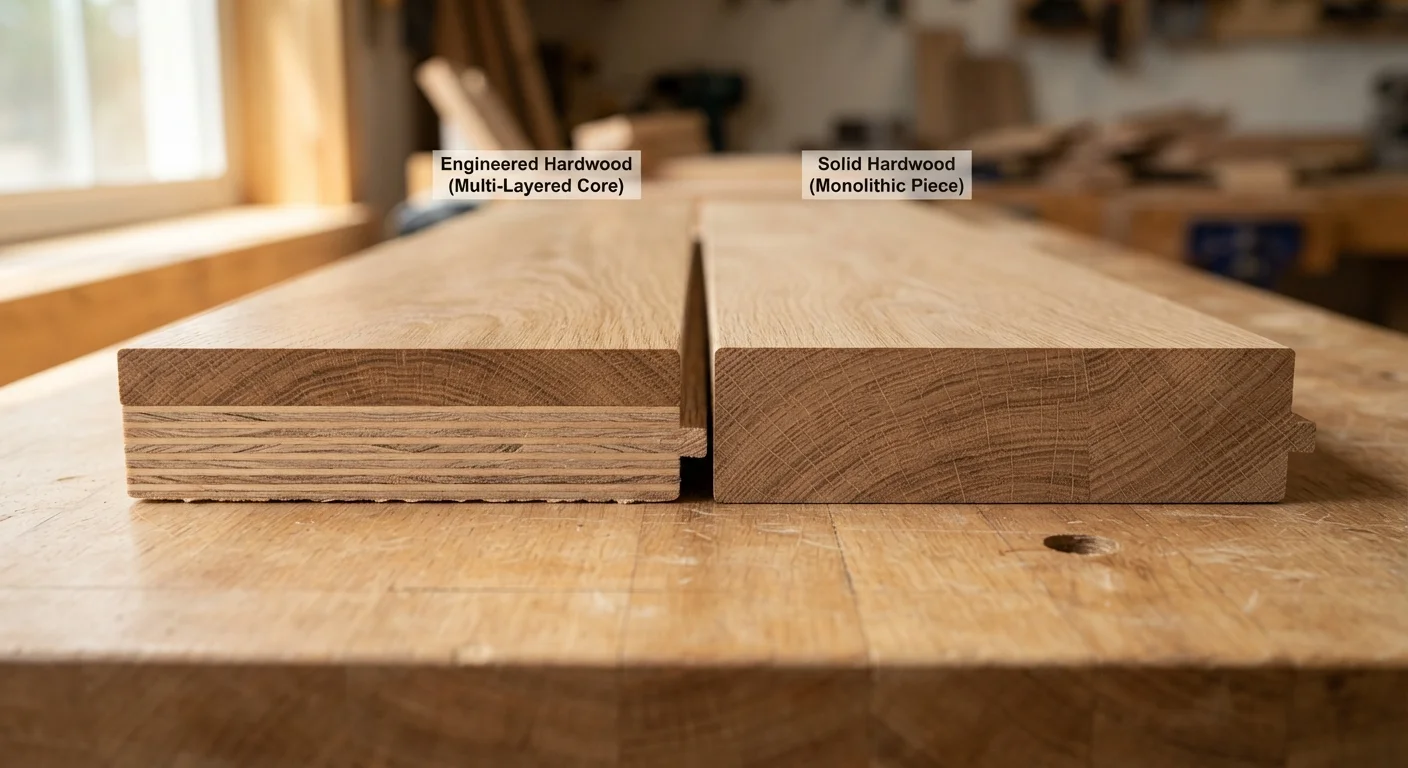
Photo credit: PrimeFaqs.com | Trending And Accurate Content
In this article
Solid and engineered hardwood look similar but behave very differently. Compare stability, refinishing potential, moisture tolerance, and installation requirements.
Key Takeaways
- Engineered hardwood resists moisture and subfloor movement better than solid hardwood due to its layered plywood core.
- Solid hardwood can typically be sanded and refinished more times over its lifetime, extending its usable lifespan.
- Engineered hardwood suits below-grade and on-grade installations; solid hardwood is generally restricted to above-grade levels.
- Both types can deliver comparable surface appearances, as both use real hardwood for the visible wear layer.
- Installation method differs significantly - engineered planks often float or glue down, while solid boards are typically nailed or stapled.
How Each Floor Is Built
The most meaningful differences between these two flooring types start beneath the surface. Understanding their construction explains nearly every practical trade-off you'll face.
Solid hardwood is exactly what its name suggests: a single piece of milled wood, typically ¾ inch thick, cut from species such as oak, maple, hickory, or walnut. Because every millimeter is real wood, it can be sanded back and refinished repeatedly - often five to eight times or more over a floor's lifetime.
Engineered hardwood is a layered product. A real hardwood veneer (the wear layer) is bonded to multiple cross-directional plywood or high-density fiberboard (HDF) plies beneath it. The wear layer thickness varies by product - generally between 1 mm and 6 mm - and determines how many refinishing cycles are realistic. Thicker wear layers allow more sanding passes before the veneer is exhausted.
| Criterion | Engineered Hardwood | Solid Hardwood |
|---|---|---|
| Core construction | Hardwood veneer over cross-ply core | Single solid wood plank |
| Typical thickness | 3/8" - 9/16" (some up to 3/4") | 3/4" standard |
| Moisture resistance | Moderate - better than solid | Low - prone to cupping and warping |
| Installation grade | Below, on, or above grade | Above grade only |
| Refinishing potential | 1-3 times (wear-layer dependent) | 5-8+ times over lifetime |
| Common installation methods | Float, glue-down, nail/staple | Nail or staple to wood subfloor |
| DIY accessibility | High (floating method) | Moderate - requires flooring nailer |
| Real wood surface | Yes (veneer wear layer) | Yes (full depth) |
Moisture, Stability, and Where Each Can Be Installed
Wood and water are natural adversaries. How each flooring type handles moisture determines where in your home it can safely go.
Solid hardwood expands and contracts with changes in relative humidity. This is normal wood behavior, but it creates real installation constraints. Most flooring manufacturers and flooring professionals recommend solid hardwood only for above-grade applications - main levels and upper floors where moisture vapor from soil and concrete isn't a factor. Wide-plank solid boards (5 inches or wider) are especially susceptible to visible movement gaps in dry winter months.
Engineered hardwood's cross-ply core counteracts wood's natural tendency to move with moisture. This construction allows installation at, on, or below grade - including over concrete slabs - making it the go-to choice for basements, slab-on-grade construction common in warmer climates, and open-plan spaces that span multiple subfloor types.
Check Subfloor Moisture Before You Buy
Subfloor moisture levels should be tested with a calibrated moisture meter before committing to either flooring type. Concrete slabs, in particular, can release moisture vapor for years after being poured. Many flooring manufacturers require documentation of acceptable moisture readings to honor installation warranties - so testing isn't optional if warranty protection matters to you.
Regardless of flooring type, always measure and record your subfloor moisture content before installation. Most wood flooring associations publish acceptable moisture thresholds for both subfloor and flooring materials. Exceeding those thresholds is a leading cause of post-installation failures.
Installation Methods and DIY Feasibility
How a floor goes down affects both the project difficulty and future flexibility.
Solid hardwood is almost always nailed or stapled to a wood subfloor using a flooring nailer. This requires a plywood or OSB subfloor at least ¾ inch thick - concrete or tile substrates aren't compatible. The process demands careful acclimation (typically 3-5 days in the installation space) and precise nailing patterns. While experienced DIYers can manage it, renting a floor nailer and working around obstacles like doorways and transitions adds complexity.
Engineered hardwood offers more installation flexibility: floating (click-lock planks laid over an underlayment), glue-down (directly to concrete or wood), or nail/staple-down. Floating installations are among the most DIY-accessible flooring projects available, making engineered hardwood popular with homeowners tackling their own renovations.
3-5 days
Typical hardwood acclimation period before installation
Wood flooring industry guidelines generally recommend acclimating planks to the installation room's conditions before laying them to reduce post-installation movement.
35-55%
Recommended indoor relative humidity range for wood floors
The National Wood Flooring Association advises maintaining indoor relative humidity within this range year-round to minimize expansion, contraction, and gapping in both solid and engineered hardwood.
In both cases, acclimating the flooring to the room's temperature and humidity before installation is essential - skip this step and even a correctly installed floor may develop gaps or buckling within the first heating season.
Refinishing, Longevity, and Long-Term Value
A floor's lifetime cost depends on more than the purchase price - refinishing cycles, durability, and replacement timing all factor in.
Solid hardwood's thick profile means a skilled flooring contractor can sand it back to bare wood and refinish it multiple times. A well-maintained solid oak floor installed in the 1970s can still be in active service today, refinished two or three times along the way. This long arc of usability makes solid hardwood compelling for homeowners with a multi-decade planning horizon.
Engineered hardwood's refinishing potential depends almost entirely on its wear-layer thickness. A product with a 2 mm wear layer may support one careful refinishing; a 6 mm layer could handle two or three passes. Always confirm the wear-layer specification with the manufacturer before purchasing if refinishing is a priority for you.
Both flooring types can be damaged by prolonged standing water, heavy pet claws, or dragging furniture without felt pads. Preventive maintenance - area rugs in high-traffic zones, humidity control between roughly 35-55% relative humidity year-round, and prompt cleanup of spills - extends the life of either option significantly.

Author
Home & Garden Editorial Team
Home & Garden Editorial Team is the collective byline for our editorial team and contributor network. Articles published under this byline or an editorial pen name are researched, written, and reviewed according to our editorial standards for clarity, consistency, and independence before publication.
View all articles →