
Anxiety and Burnout: Where One Ends and the Other Begins
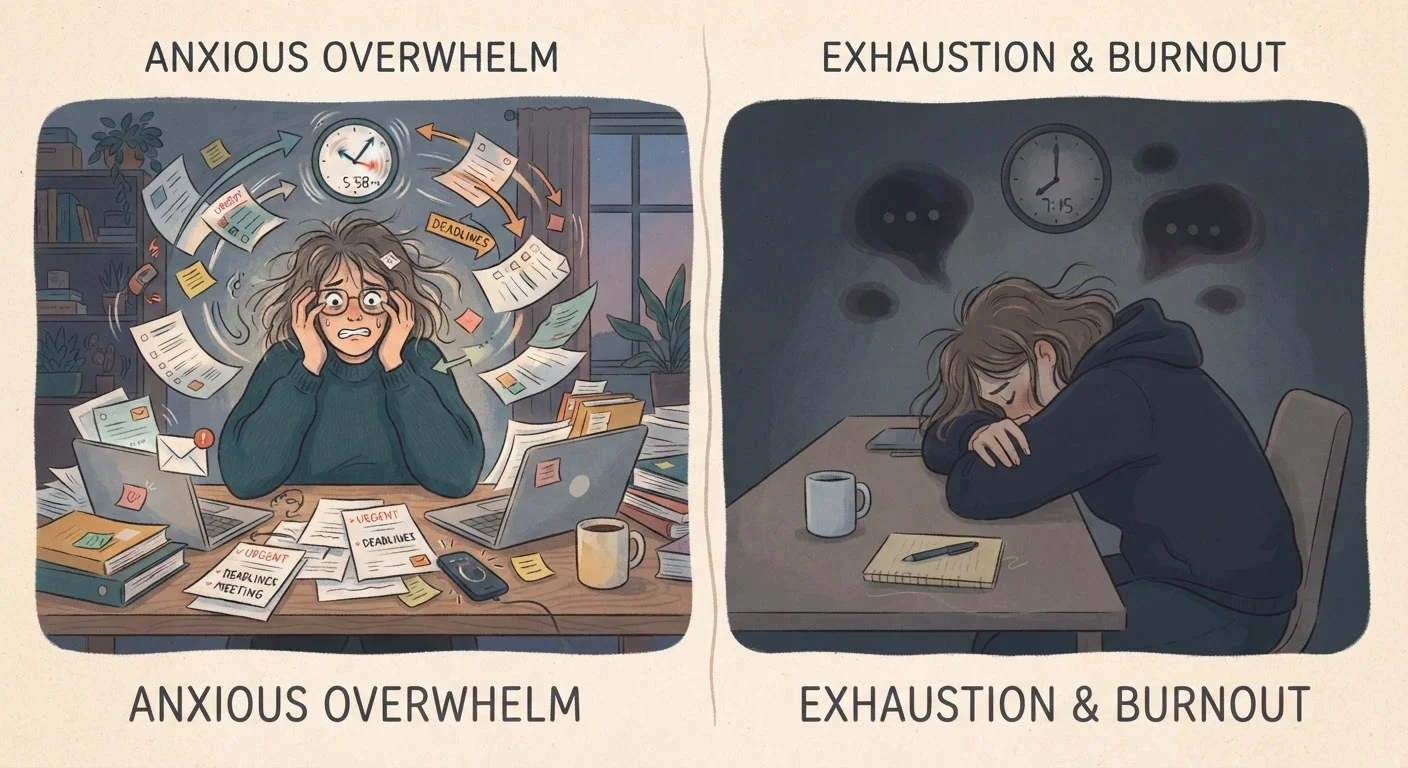
Photo credit: PrimeFaqs.com | Trending And Accurate Content
In this article
Anxiety and burnout share symptoms but have different roots and responses. Learn how to tell them apart and why it matters for recovery.
Key Takeaways
- Anxiety tends to involve heightened arousal and worry about future threats; burnout involves emotional and physical depletion from sustained overload.
- Both conditions can coexist and share symptoms like fatigue and difficulty concentrating, making accurate self-assessment important.
- Anxiety often responds to techniques that calm the nervous system; burnout typically requires rest, boundary-setting, and workload reduction.
- Misidentifying one as the other can lead to strategies that worsen rather than improve your condition.
- A qualified mental health professional is the most reliable guide for distinguishing and treating either condition.
What Makes Anxiety Distinct
Anxiety, as defined by mental health frameworks including the DSM-5 (the Diagnostic and Statistical Manual of Mental Disorders), centers on persistent, excessive worry about a range of future events or circumstances. The nervous system enters a state of heightened alert - sometimes called the fight-or-flight response - even when no immediate threat is present.
Common markers include racing thoughts, restlessness, muscle tension, difficulty sleeping, and an inability to "switch off" mentally. Crucially, anxiety often comes with a sense of urgency: there is something to figure out, prepare for, or prevent. That mental motor keeps running regardless of how much rest a person gets.
Anxiety disorders are among the most common mental health conditions in the United States, affecting tens of millions of adults, according to the National Institute of Mental Health. The condition exists on a spectrum - from situational stress responses to clinical disorders - and a licensed mental health professional is best placed to assess where someone falls on that spectrum.
Anxiety Is Not Just "Stress"
While everyday stress and anxiety share some features, clinical anxiety involves a nervous system that remains activated beyond what the situation warrants - sometimes without any identifiable trigger. It's a meaningful distinction because stress typically resolves when the stressor does, whereas anxiety may persist independently. If symptoms are persistent or impairing daily functioning, speaking with a mental health professional is strongly recommended.
What Makes Burnout Distinct
Burnout is not a clinical diagnosis in the DSM-5, but the World Health Organization classifies it as an occupational phenomenon - the result of chronic workplace stress that has not been successfully managed. Researchers Christina Maslach and Michael Leiter identified three core dimensions: emotional exhaustion, depersonalization (a cynical or detached relationship to your work or role), and a reduced sense of personal accomplishment.
Where anxiety revs the engine, burnout drains the tank. People experiencing burnout often describe feeling hollow, indifferent, or profoundly tired - even after sleep. Tasks that once felt meaningful may feel pointless. Unlike anxiety's future-focused worry, burnout tends to produce a flat, disengaged present-tense state.
Because burnout develops gradually through sustained overload, it often goes unnoticed until functioning is significantly impaired. Understanding the difference between mental health and mental wellness can help contextualize where burnout fits in the broader picture.
~19%
U.S. adults affected by anxiety disorders annually
According to the National Institute of Mental Health, anxiety disorders are among the most prevalent mental health conditions in the United States.
77%
Workers who have experienced burnout at current job
A Deloitte Workplace Burnout Survey found a substantial majority of professionals reported burnout, highlighting how widespread the phenomenon has become.
Where They Overlap - and Why That Matters
The two conditions share enough surface-level symptoms - fatigue, concentration difficulties, irritability, disrupted sleep - that they are frequently confused, even by the individuals experiencing them. This overlap matters because the wrong strategy can backfire.
For example, a person with anxiety who interprets their symptoms as burnout may attempt to push through by resting and disengaging - but without addressing the underlying hyperarousal, rest alone rarely resolves anxiety. Conversely, someone burned out who treats their exhaustion as anxiety may pursue stimulating coping strategies (like high-intensity exercise or productivity systems) that further deplete limited reserves.
| Criterion | Anxiety | Burnout |
|---|---|---|
| Core experience | Hyperarousal, worry, dread | Depletion, numbness, disengagement |
| Time orientation | Future-focused fear | Flat, exhausted present |
| Energy level | Often wired, restless | Profoundly low, hollow |
| Effect of rest | Often insufficient alone | Necessary but not always sufficient |
| Primary cause | Nervous system dysregulation | Chronic, unrelieved occupational stress |
| Clinical status | Recognized clinical condition (DSM-5) | Occupational phenomenon (WHO) |
| Key recovery approach | Nervous system regulation, CBT | Structural change, rest, boundary-setting |
It's also common for both conditions to be present simultaneously. Chronic anxiety is itself a stressor that, over time, can contribute to burnout. Recognizing this interaction is part of why professional evaluation is so valuable. If you're unsure where your experience falls, starting the conversation with a therapist is a concrete, accessible next step.
Recovery Looks Different for Each
Once you have a clearer sense of what you're dealing with, recovery approaches can be more precisely matched. For anxiety, evidence-based interventions often include cognitive behavioral therapy (CBT), mindfulness-based stress reduction, and in some cases medication - all under professional guidance. The goal is to regulate an overactive nervous system and develop more balanced thinking patterns.
For burnout, structural changes typically matter more: reducing workload, establishing firm boundaries, recovering a sense of autonomy, and rebuilding sources of meaning and connection. Rest is necessary but usually not sufficient on its own - the conditions that caused the depletion also need to change. Some common coping strategies may quietly deepen the problem, so it's worth examining whether your current habits are genuinely restorative.
Reflective practices such as journaling can support recovery from both conditions, though in different ways. Different journaling approaches serve different needs - expressive writing may help process anxious thoughts, while gratitude or values-based journaling may help burnout recovery by reconnecting someone to what matters.
This article is for general informational and educational purposes only and is not a substitute for professional medical or mental health advice, diagnosis, or treatment. If you are experiencing significant distress, please consult a qualified healthcare or mental health professional.

Author
Health & Wellness Editorial Team
Health & Wellness Editorial Team is the collective byline for our editorial team and contributor network. Articles published under this byline or an editorial pen name are researched, written, and reviewed according to our editorial standards for clarity, consistency, and independence before publication.
View all articles →