
Home Workouts vs. Gym Training: Weighing the Real Trade-Offs
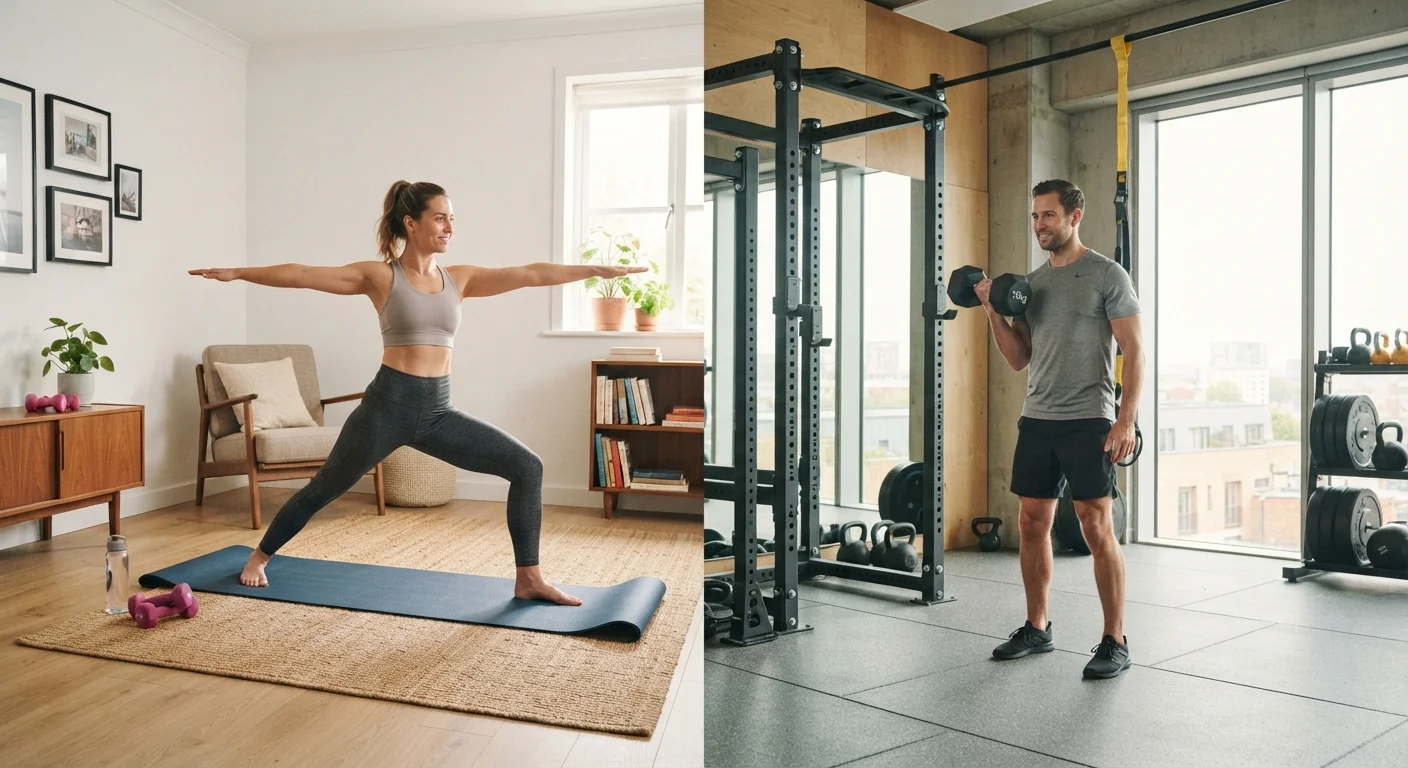
Photo credit: PrimeFaqs.com | Trending And Accurate Content
In this article
Neither approach works for everyone. Compare the practical advantages and limitations of exercising at home versus a gym setting.
Key Takeaways
- Home workouts eliminate commute time and membership costs, lowering the barrier to consistent exercise.
- Gyms provide access to a wider range of equipment and professional guidance that home setups rarely match.
- Neither setting is universally superior - the best choice depends on your goals, schedule, and budget.
- Many people find that combining both approaches delivers the most sustainable long-term fitness habits.
- Consistency matters more than location when it comes to achieving meaningful fitness results.
No commute saves significant time each session
Eliminating travel to and from a facility can free up 30-60 minutes per workout, making it easier to fit exercise into a busy schedule consistently.
Lower ongoing financial commitment
After initial equipment costs, home training avoids monthly membership fees, which in many U.S. cities range from $30 to over $100 per month.
Full control over environment and schedule
You can train at any hour, adjust the temperature, play your own music, and avoid waiting for equipment - conditions that reduce session friction.
Greater privacy reduces social anxiety
For beginners or those self-conscious about their fitness level, training at home removes the social pressure that can prevent people from starting altogether.
Gym offers access to specialized equipment
Barbells, cable systems, and heavy resistance machines support a broader range of training goals than most home setups can reasonably replicate.
Professional coaching is more accessible
Certified trainers and group instructors on-site can provide real-time form correction, reducing injury risk and improving program effectiveness.
Social atmosphere supports motivation
Exercising alongside others has been associated with greater exercise adherence and perceived effort in peer-reviewed research on group fitness behavior.
Home distractions undermine training focus
Household chores, family interruptions, and the psychological comfort of home can make it difficult to maintain the mental separation needed for effective training.
Equipment limitations cap certain fitness goals
Building maximal strength or training for sport-specific performance is difficult without access to heavy free weights and specialized machines rarely found in home gyms.
Gym membership costs add up over time
A typical gym membership in the United States costs hundreds of dollars annually, and unused memberships represent a common source of unnecessary personal expense.
Peak-hour crowding reduces workout efficiency
Popular equipment at busy gyms can require long waits during evenings and weekends, disrupting planned workout structure and extending session time.
Social environment can feel intimidating
Many beginners report feeling self-conscious or judged at commercial gyms, which can create a barrier to attendance that undermines the membership's value.
The Core Question: Where Will You Actually Show Up?
When evaluating home workouts versus gym training, the most important variable is not which setting is objectively superior - it is which one you will use consistently. Research in exercise science consistently shows that adherence is the single strongest predictor of long-term fitness outcomes, regardless of program design or equipment quality. Before comparing features, it is worth being honest about your own patterns: do you need external structure to stay motivated, or do you thrive with the autonomy of training on your own schedule?
Both environments are capable of supporting meaningful fitness progress. Common exercise myths often inflate the importance of any one setting, but the evidence points to a simpler truth: movement done regularly in a space that works for your life beats the theoretically optimal workout you rarely complete.
No commute saves significant time each session
Eliminating travel to and from a facility can free up 30-60 minutes per workout, making it easier to fit exercise into a busy schedule consistently.
Lower ongoing financial commitment
After initial equipment costs, home training avoids monthly membership fees, which in many U.S. cities range from $30 to over $100 per month.
Full control over environment and schedule
You can train at any hour, adjust the temperature, play your own music, and avoid waiting for equipment - conditions that reduce session friction.
Greater privacy reduces social anxiety
For beginners or those self-conscious about their fitness level, training at home removes the social pressure that can prevent people from starting altogether.
Gym offers access to specialized equipment
Barbells, cable systems, and heavy resistance machines support a broader range of training goals than most home setups can reasonably replicate.
Professional coaching is more accessible
Certified trainers and group instructors on-site can provide real-time form correction, reducing injury risk and improving program effectiveness.
Social atmosphere supports motivation
Exercising alongside others has been associated with greater exercise adherence and perceived effort in peer-reviewed research on group fitness behavior.
Where Home Workouts Have a Real Edge
Training at home removes several friction points that cause people to skip sessions. There is no commute, no waiting for equipment, and no need to align your schedule with facility hours. For caregivers, shift workers, or anyone with an unpredictable day, this flexibility can be the difference between exercising and not exercising at all.
Cost is another practical advantage. After any initial investment in basic equipment - such as resistance bands, a set of adjustable dumbbells, or a pull-up bar - the ongoing expense of home training is minimal. Over a few years, the savings compared to a gym membership can be substantial, particularly in higher-cost urban areas.
Privacy is a factor many beginners underestimate. Starting a fitness routine can feel vulnerable, and the absence of social comparison at home removes a genuine barrier for people who are self-conscious about their current fitness level. If exercise-related anxiety has kept you out of a gym, training at home is a legitimate and productive starting point. Low-intensity options like walking can also be incorporated seamlessly when you control your own environment.
Where the Gym Holds a Clear Advantage
The gym's primary strength is equipment diversity. Cable machines, barbells with heavy plate stacks, specialized cardio equipment, and resistance machines allow for a range of training stimuli that a home setup simply cannot replicate without significant space and expenditure. For goals such as building maximal strength, training for a sport, or rehabilitating an injury under professional supervision, this access is often essential.
Professional guidance is also more accessible in a gym environment. Certified personal trainers, group fitness instructors, and - in some facilities - physical therapists are available to provide technique correction and program design. Proper form is particularly important for compound movements like squats and deadlifts; learning these with qualified oversight reduces injury risk. Understanding how to balance cardio and strength is also easier when a trained professional can assess your specific needs.
Social environment is an often-cited motivator. For many people, being around others who are exercising creates a sense of accountability and energy that is hard to reproduce at home. Group classes in particular offer structured programming, instructor-led intensity, and community connection - elements with documented effects on exercise adherence.
Home distractions undermine training focus
Household chores, family interruptions, and the psychological comfort of home can make it difficult to maintain the mental separation needed for effective training.
Equipment limitations cap certain fitness goals
Building maximal strength or training for sport-specific performance is difficult without access to heavy free weights and specialized machines rarely found in home gyms.
Gym membership costs add up over time
A typical gym membership in the United States costs hundreds of dollars annually, and unused memberships represent a common source of unnecessary personal expense.
Peak-hour crowding reduces workout efficiency
Popular equipment at busy gyms can require long waits during evenings and weekends, disrupting planned workout structure and extending session time.
Social environment can feel intimidating
Many beginners report feeling self-conscious or judged at commercial gyms, which can create a barrier to attendance that undermines the membership's value.
Limitations Worth Acknowledging on Both Sides
Home training has real constraints beyond just equipment. Distractions are constant - household tasks, family members, or simply the comfort of familiar surroundings can erode focus. Without a designated and well-equipped space, the psychological separation between "rest mode" and "training mode" becomes harder to establish. Motivation can also drift without external accountability structures.
Gyms are not without drawbacks either. Membership costs, peak-hour crowding, travel time, and rigid operating hours are all practical obstacles. Some people find the gym environment intimidating or socially uncomfortable, particularly when starting out. And committing to a monthly fee does not automatically translate into attendance - many memberships go chronically underused.
Combining Both Approaches Is a Valid Strategy
Many fitness professionals suggest a hybrid model - using home workouts for shorter, convenience-driven sessions and the gym for longer, equipment-dependent training days. This approach reduces the all-or-nothing pressure that leads to dropout when one setting becomes temporarily unavailable. It also allows you to develop a baseline of fitness at home before investing in a gym membership.
Ultimately, neither setting eliminates the need for a thoughtful approach to programming. Recovery and rest matter equally whether you train at home or in a facility, and a well-structured plan will always outperform random, ad hoc sessions in either location.
This article is for general informational purposes only and does not constitute medical or professional fitness advice. Consult a qualified healthcare provider or certified fitness professional before beginning a new exercise program, particularly if you have an existing health condition.

Author
Health & Wellness Editorial Team
Health & Wellness Editorial Team is the collective byline for our editorial team and contributor network. Articles published under this byline or an editorial pen name are researched, written, and reviewed according to our editorial standards for clarity, consistency, and independence before publication.
View all articles →