
Free vs. Paid Online Courses: When the Price Tag Actually Matters
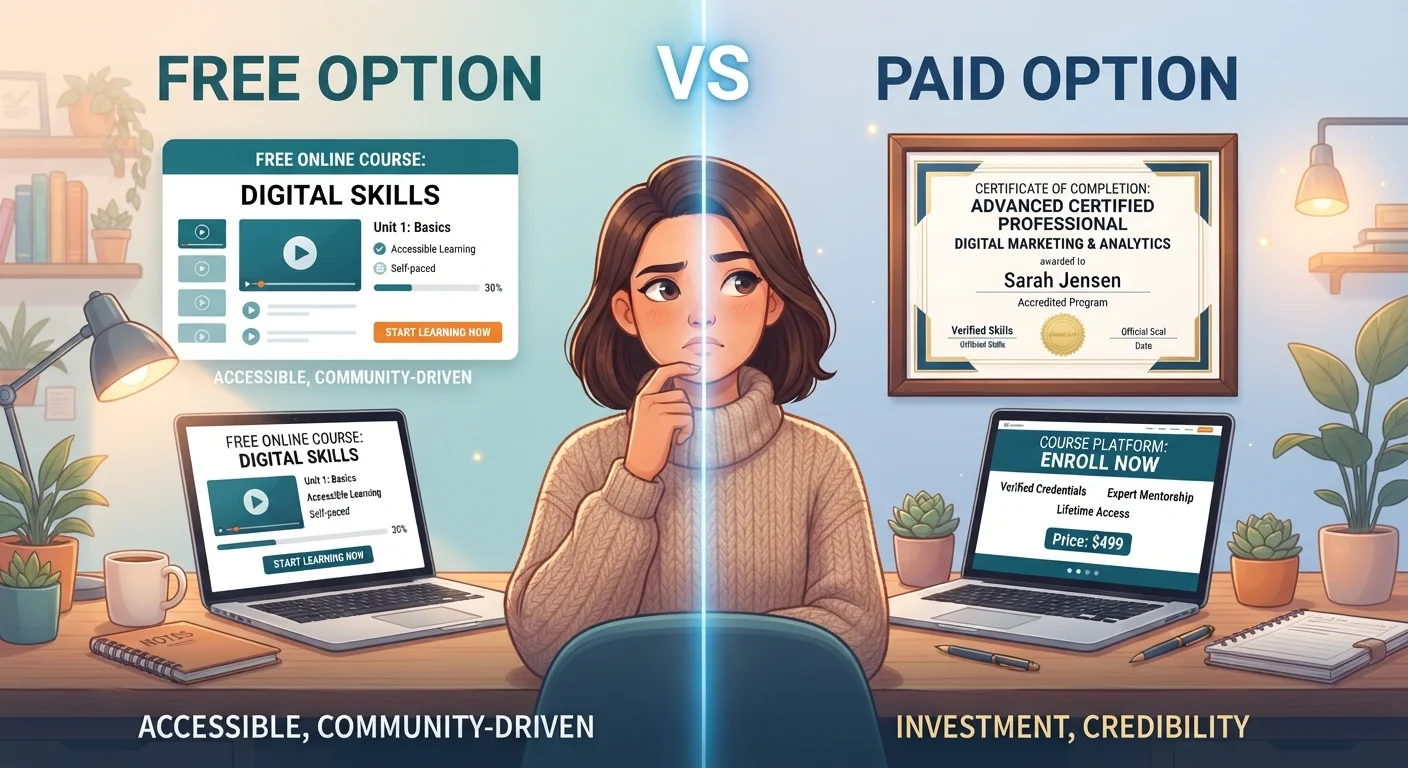
Photo credit: PrimeFaqs.com | Trending And Accurate Content
In this article
Free courses aren't always lesser, and paid ones aren't always worth it. Here's a framework for evaluating online learning costs honestly.
Key Takeaways
- Free courses can be genuinely high-quality, but they rarely provide credentials employers recognize.
- Paid courses are worth the investment when a certificate, structured feedback, or accountability is essential to your goal.
- The right choice depends on your purpose: exploration, skill-building, or credentialed advancement.
- Audit options let learners access paid course content for free, though usually without a certificate.
- Always evaluate course quality independently of price before enrolling.
Why Price Alone Is a Poor Proxy for Quality
The online learning market has grown dramatically, and with it has come a persistent myth: that expensive courses are inherently more valuable. The reality is more nuanced. A free course offered by a respected university through an open platform can be academically rigorous, while a costly course on a commercial platform may deliver little beyond pre-recorded video and a downloadable PDF.
Price reflects many things - production costs, platform overhead, instructor compensation, and marketing budgets - but it does not automatically reflect learning quality. Before assuming a course is worth its price tag, or dismissing a free one, it helps to understand what each model actually offers and where the real differences lie.
For a broader look at evaluating course quality regardless of cost, see our guide on how to evaluate an online course before committing your time and money.
What Free Courses Genuinely Offer
Free online courses - including open courseware from universities, platform audit tracks, and community-built resources - have real strengths. Many cover foundational and intermediate content thoroughly. Motivated learners can build genuine skills in programming, data analysis, writing, foreign language acquisition, and dozens of other areas without spending anything.
The core limitations tend to be structural rather than academic:
- No recognized credential: Completion typically earns a certificate of participation, if anything, that carries limited weight with employers or admissions committees.
- No instructor interaction: Most free courses are self-paced with pre-recorded content and no direct feedback on your work.
- Lower accountability structures: Without deadlines or cohorts, completion rates for free courses are notoriously low - a pattern documented consistently across open platforms.
Free courses are well-suited to learners who are exploring a subject, supplementing formal education, or building skills for personal application rather than credentialing.
Try Before You Commit
Many paid platforms offer free preview lessons or a limited audit track. If you're uncertain whether a course matches your learning style or fills your knowledge gaps, start with free preview content before purchasing. Spending time upfront to evaluate fit can save both money and frustration later.
When Paid Courses Justify the Cost
Paid courses earn their price when they provide something a free alternative structurally cannot. The clearest cases include:
- Accredited or employer-recognized certificates: Certain professional certificates - in fields like project management, data science, or cybersecurity - carry measurable weight in hiring contexts. These require verified completion and are typically only available through paid enrollment.
- Instructor feedback and graded assessments: Courses where an expert reviews your work, provides critique, and evaluates your progress offer a qualitatively different learning experience.
- Cohort-based accountability: Structured timelines and peer interaction improve completion rates and, for many learners, depth of engagement.
- Career services and networking access: Some paid programs bundle mentorship, job placement support, or alumni community access - benefits that extend beyond the curriculum itself.
It's also worth noting that some platforms allow learners to audit paid courses - accessing content for free without receiving a certificate. This is a practical middle path when the learning itself, not the credential, is the goal. Understanding how format affects your experience is equally important; our overview of self-paced vs. instructor-led online courses can help you decide which structure fits your life.
| Free Courses | Paid Courses | |
|---|---|---|
| Cost | No financial cost | Ranges from modest to substantial |
| Credential / Certificate | Rarely recognized externally | Often employer- or institution-recognized |
| Instructor Interaction | Typically none | Often available; varies by format |
| Accountability Structures | Self-directed; no deadlines | Deadlines, cohorts, graded work |
| Content Quality | Varies widely; can be excellent | Varies widely; not guaranteed by price |
| Best For | Exploration, personal development | Credentialing, career advancement |
A Framework for Making the Decision
Before spending - or not spending - consider these four questions:
- What is the end goal? If you need a credential that signals competency to a third party (an employer, a licensing board, an admissions committee), a free course will rarely suffice. If you want to learn something for personal use, free content may be entirely adequate.
- Who created and teaches the course? A course taught by a verifiable subject-matter expert with an established record carries more weight than one from an anonymous instructor, regardless of price. Check instructor credentials independently.
- What does the platform's track record look like? Not all paid platforms are trustworthy, and not all free ones are fly-by-night. Our article on signals that an online course or platform may not be legitimate walks through specific red flags to watch for.
- What are the refund and enrollment policies? For paid courses, always review refund windows and cancellation terms before enrolling. Our pre-enrollment checklist covers this and other critical details.
The online education landscape can be confusing, but clarity comes from focusing on outcomes rather than price. A well-matched free course beats an expensive mismatch every time.

Author
Education & Learning Editorial Team
Education & Learning Editorial Team is the collective byline for our editorial team and contributor network. Articles published under this byline or an editorial pen name are researched, written, and reviewed according to our editorial standards for clarity, consistency, and independence before publication.
View all articles →