
Community College vs. Four-Year University: Weighing the Trade-Offs
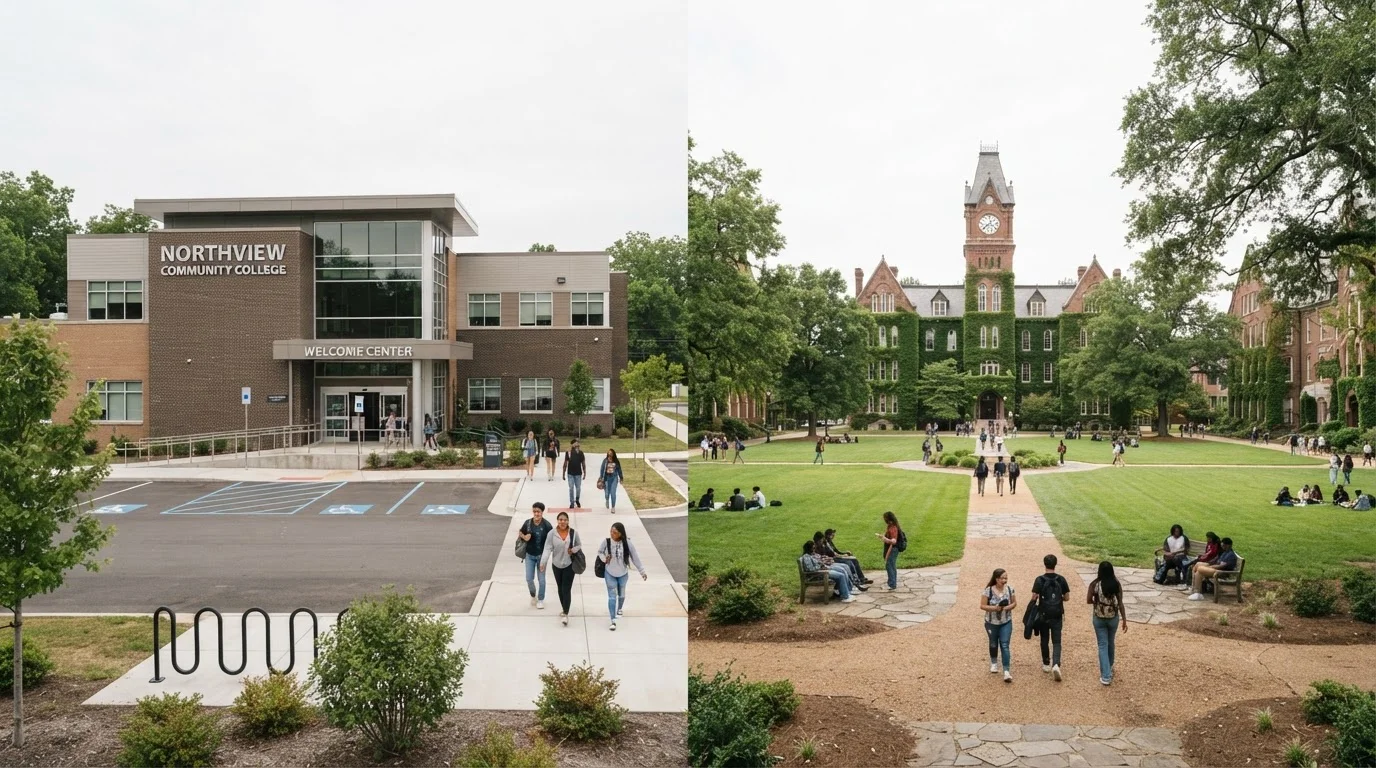
Photo credit: PrimeFaqs.com | Trending And Accurate Content
In this article
A clear-eyed look at cost, academic experience, transfer pathways, and outcomes to help students and families make an informed choice.
Key Takeaways
- Community colleges typically cost significantly less per credit hour than four-year universities, reducing early debt exposure.
- Transfer pathways from community college to four-year schools are well-established but require careful planning to protect credits.
- Four-year universities generally offer more on-campus resources, residential life, and direct access to bachelor's-level programs.
- Neither path is universally superior - the right choice depends on finances, academic goals, and personal circumstances.
- Earning an associate degree before transferring can strengthen a student's academic record and lower total degree costs.
The Cost Difference Is Real - but So Is the Full Picture
Tuition is usually the first number families look at, and for good reason. According to the College Board, the average published tuition and fees at public two-year colleges are a fraction of what public four-year institutions charge in-state - and far less than private four-year schools. That gap compounds over two years of general education coursework.
However, published tuition is rarely what families actually pay. Financial aid, grants, and scholarships can close the gap meaningfully at four-year schools. Before drawing conclusions from sticker prices alone, it helps to understand the difference between published and net costs. Our article net price vs. sticker price explains exactly how to calculate what a school is likely to cost your family. Similarly, understanding how financial aid packages are assembled matters - see how financial aid packages break down before accepting any offer.
The cost calculation should also include living expenses, transportation, and opportunity cost - all of which vary considerably depending on whether a student lives at home, on campus, or independently.
~$3,990
Average annual tuition at public two-year colleges
According to College Board's Trends in College Pricing report, average published tuition and fees at public two-year colleges are substantially below those at four-year institutions.
~45%
U.S. undergraduates enrolled at two-year colleges
The American Association of Community Colleges estimates that community colleges enroll roughly 45% of all U.S. undergraduates, reflecting their central role in higher education access.
39 states
States with statewide transfer articulation agreements
According to the Education Commission of the States, a large majority of states have formal statewide articulation policies designed to protect community college transfer credits.
Academic Experience: What Each Path Actually Offers
Community colleges serve an extraordinarily diverse student population - recent high school graduates, working adults, career changers, and students pursuing vocational credentials alongside transfer-track courses. Class sizes are often smaller than introductory lectures at large universities, and instructors typically focus solely on teaching rather than research. That can mean more accessible faculty and a supportive environment for students still developing college-level study habits.
Four-year universities, by contrast, offer the full range of a bachelor's degree experience from day one: research opportunities, specialized faculty, a wider variety of major programs, graduate and professional school pipelines, and campus resources ranging from academic advising to career centers. For students who know what they want to study - particularly in fields with specific accreditation requirements - beginning at a four-year institution avoids the complexity of credit transfer. If you're working through that decision, choosing a college major is a useful companion read.
| Criterion | Community College | Four-Year University |
|---|---|---|
| Average tuition (public, in-state) | Lower per credit hour | Higher per credit hour |
| Time to bachelor's degree | Typically 4 years (2+2 transfer) | Typically 4 years direct |
| Residential campus life | Limited or unavailable | Widely available |
| Schedule flexibility | High - evening/weekend options | Moderate - varies by school |
| Range of bachelor's programs | None (associate degrees only) | Broad - dozens to hundreds |
| Class size (introductory courses) | Often smaller | Often larger lecture format |
| Transfer credit complexity | Requires careful planning | Not applicable |
| On-campus career services | Variable, often limited | Typically robust |
Transfer Pathways: Opportunity With Conditions
One of the most important - and sometimes misunderstood - aspects of starting at a community college is the transfer pathway. Many states have formal articulation agreements between their community college systems and public four-year universities, guaranteeing that credits earned in transferable courses will apply toward a bachelor's degree. In some cases, completing an associate degree and meeting GPA requirements grants priority admission to in-state universities.
The critical caveat: not all credits transfer equally, and transfer agreements vary by state, institution, and major. Students who plan to transfer should identify their target four-year school early, meet with an academic counselor before registering for courses, and confirm which credits will count. Taking courses outside the agreed transfer curriculum - or switching target schools late - can result in lost credits, added semesters, and unexpected costs.
For students still assembling a list of potential schools, building a college list that actually fits your goals offers a structured framework for evaluating options beyond rankings and reputation.
Check Transfer Agreements Before You Register
Most community colleges publish transfer guides specific to partner four-year institutions. These documents list exactly which courses satisfy which requirements at the receiving school. Reviewing them before your first semester - not after - is the single most effective way to avoid losing credits. Your community college's transfer counseling office is the right starting point.
Outcomes and the Longer View
Does where you start college affect where you end up? Research on this question is nuanced. Studies suggest that students who successfully transfer from community college to a four-year university and earn a bachelor's degree achieve labor market outcomes broadly comparable to students who began at a four-year school. The degree itself - not the starting institution - tends to be the primary credential employers evaluate.
That said, completion rates differ. Community college students face higher rates of stopping out before finishing, often due to financial pressure, work obligations, or life circumstances rather than academic ability. Students who enroll in community college with a clear transfer plan and access to advising complete at higher rates than those without structured support. First-generation students in particular benefit from understanding the full landscape early - navigating college applications as a first-generation student addresses many of the structural gaps that can slow progress.
Internships and professional experiences during college also shape outcomes independently of institution type. What makes internships worth your time is worth reading regardless of which path you choose.
This article is for general informational and educational purposes only. Costs, transfer policies, and program requirements vary by state and institution. Students and families should consult directly with institutional advisors and official state education resources before making enrollment decisions.

Author
Education & Learning Editorial Team
Education & Learning Editorial Team is the collective byline for our editorial team and contributor network. Articles published under this byline or an editorial pen name are researched, written, and reviewed according to our editorial standards for clarity, consistency, and independence before publication.
View all articles →